Coarse crushing prepares oversized dry pieces for the next operation. In botanical and condiment processing, the objective may be to make dried roots, bark or broken blocks feed more consistently into a fine mill. The coarse stage should deliver manageable pieces without being asked to perform the entire fine-powder duty.
Grinding serves the next process. Feed preparation, controlled particle reduction and receiving equipment should form one connected material route. Define whether the powder will be blended, screened or packed, and explain what condition that operation needs from milling.
- A coarse crusher acts on incoming pieces before final milling. The WF page describes a rotating blade working with a fixed cutter inside the chamber. Feed enters through the hopper, undergoes cutting and crushing, and passes through a sieve toward the outlet. The sieve and cutting action work together to establish the preliminary discharge condition.
- A coarse grinding machine therefore needs a clearly defined inlet. Describe the largest pieces, their shape, moisture and tendency to bend or splinter. Long fibrous fragments can behave differently from compact brittle chunks even when their approximate dimensions look similar. An agreed feed preparation step is more useful than a general description such as dried herbs.
- The coarse pulverizer should be connected to the next machine through a controlled transfer. A fine mill may need a more consistent inlet than the rough crusher produces during occasional large-piece feeding. A suitable receiver or metering stage can separate these operating rhythms. Confirm this interface in the process scope instead of treating it as an installation detail.
- An industrial coarse grinder can serve as a preparation stage for compatible dry botanical pieces and other agreed feeds. It should not automatically be described as suitable for every root, resin or extract block. Sticky extracts, damp pieces and tough fibres can require a different preparation route. Material suitability belongs to the actual grade and incoming condition.
- One advantage of staged reduction is that each machine receives a more focused duty. Preliminary cutting addresses large pieces; a later mill addresses fine powder formation. This can make feed handling easier to organize and maintenance responsibilities clearer. It is not evidence of a universal energy saving, improved yield or guaranteed increase in production rate.
- Plan access to the cutting chamber and screen as part of the daily workflow. Retained fragments can carry the previous material into the next batch, particularly when different botanicals share the machine. Explain how the unit will be emptied, inspected and cleaned, and how operators will confirm that the next feed is correctly identified before production starts.
- FAO describes a dry grinder as a means of preparing ingredients for mixing and subsequent manufacturing. The broader lesson for botanical preparation is to define what the next operation needs. Coarse reduction should solve an inlet-handling problem rather than being judged only by the appearance of the discharged pieces. Read the FAO compound feed manufacturing manual for the supporting context.
- FAO identifies incoming quality, processing, packaging and storage as connected concerns for herbs and spices. Preliminary cutting cannot substitute for sorting and clean raw material. Keep rejected foreign matter and unsuitable botanical pieces out of the intended process feed before they enter the crusher hopper. Read the FAO herb and spice processing guidance for the supporting context.
- CCOHS describes housekeeping as an ongoing activity that includes material flow, dust removal and clear work areas. Include dust released at coarse-crusher feeding and discharge in the housekeeping plan. A coarse product does not mean that the operation generates no fine particles. Choose a suitable removal method and define responsibility for cleaning the receiver and surrounding surfaces. Read the CCOHS housekeeping guidance for supporting context.
- CCOHS explains that guarding protects people from hazards associated with moving machinery. The coarse crusher has cutting elements, so feeding and chamber access need a defined arrangement. Review how a blockage will be addressed without improvising access to the cutter while the machine remains capable of movement. Read the CCOHS working around machinery guidance for the supporting context.
- FDA has assessed pathogens and filth in spices as distinct public-health concerns. A coarse crusher reduces piece size; it is not a microbial decontamination treatment. Define any required spice safety treatment separately and preserve the identity of material that has already completed that treatment. Read the FDA spice risk profile for the supporting context.
- Specify a practical production cycle. Include loading, processing, discharge, inspection and changeover when discussing the required output. Give QUANPIN the complete formulation, feed condition, bulk density, target batch or hourly duty and downstream equipment arrangement. Request a configuration review with representative material before committing to the final scope. Acceptance should describe the usable product and operating conditions, rather than an unsupported promise of perfect powder or uniformity.
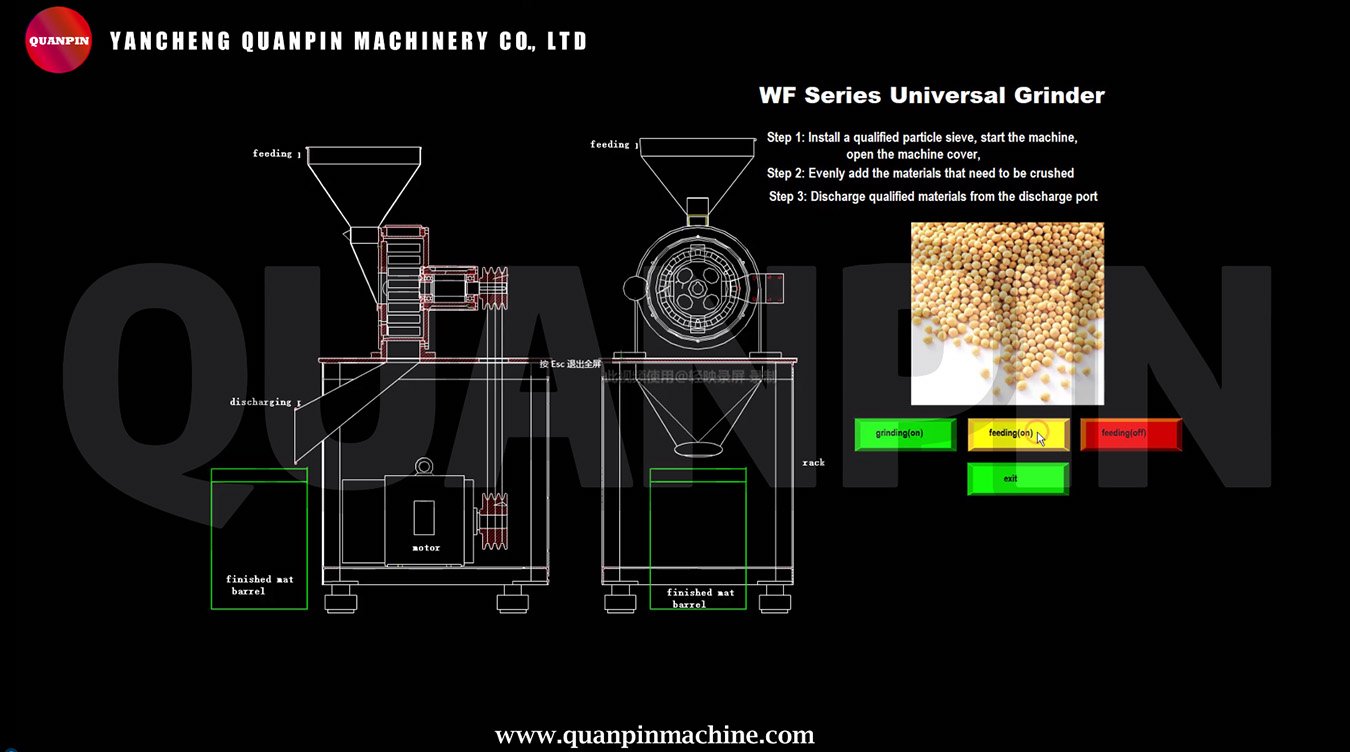
For process evaluation, consider the pharmaceutical coarse crusher for initial coarse size reduction; the pulverizer machine for grinding suitable prepared dry feed; and the air classifier mill for fine grinding with air classification. Confirm suitability with representative material, the required product properties and the proposed process conditions.
YANCHENG QUANPIN MACHINERY CO.. LTD
Sales Manager – Stacie Tang
MP: +86 19850785582
Tel: +86 0515-69038899
E-mail: stacie@qpdryer.com
WhatsAPP: 8615921493205
https://quanpindrying.en.alibaba.com/
Address: Jiangsu Province, China.