1. Drying rate of drying equipment
1. The weight lost by the material in unit time and unit area is called drying rate.
2. Drying process.
● Initial period: The time is short, in order to adjust the material to the same situation as the dryer.
● Constant speed period: This is the first period with the highest drying rate. The water evaporated from the surface of the material is replenished inside, so the surface water film is still there and kept at the wet bulb temperature.
● Phase 1 of deceleration: At this time, the evaporated water cannot be completely replenished inside, so the surface water film begins to rupture, and the drying rate begins to slow down. The material is called the critical point at this point, and the water contained at this time is called is the critical moisture.
● Phase 2 of deceleration: This phase is only available for dense materials, because water is not easy to come up; but not for porous materials. In the first phase, the evaporation of water is mostly carried out on the surface. In the second phase, the water film on the surface is completely gone, so the water diffuses to the surface in the form of water vapor.
2. Factors affecting the constant speed drying rate
● Air temperature: if the temperature is increased, the diffusion rate and the evaporation rate of sweat will increase.
● Humidity of the air: When the humidity is lower, the evaporation rate of water becomes larger.
● Airflow speed: the faster the speed, the better the mass transfer and heat transfer.
● Shrinkage and case hardening: Both phenomena will affect drying.
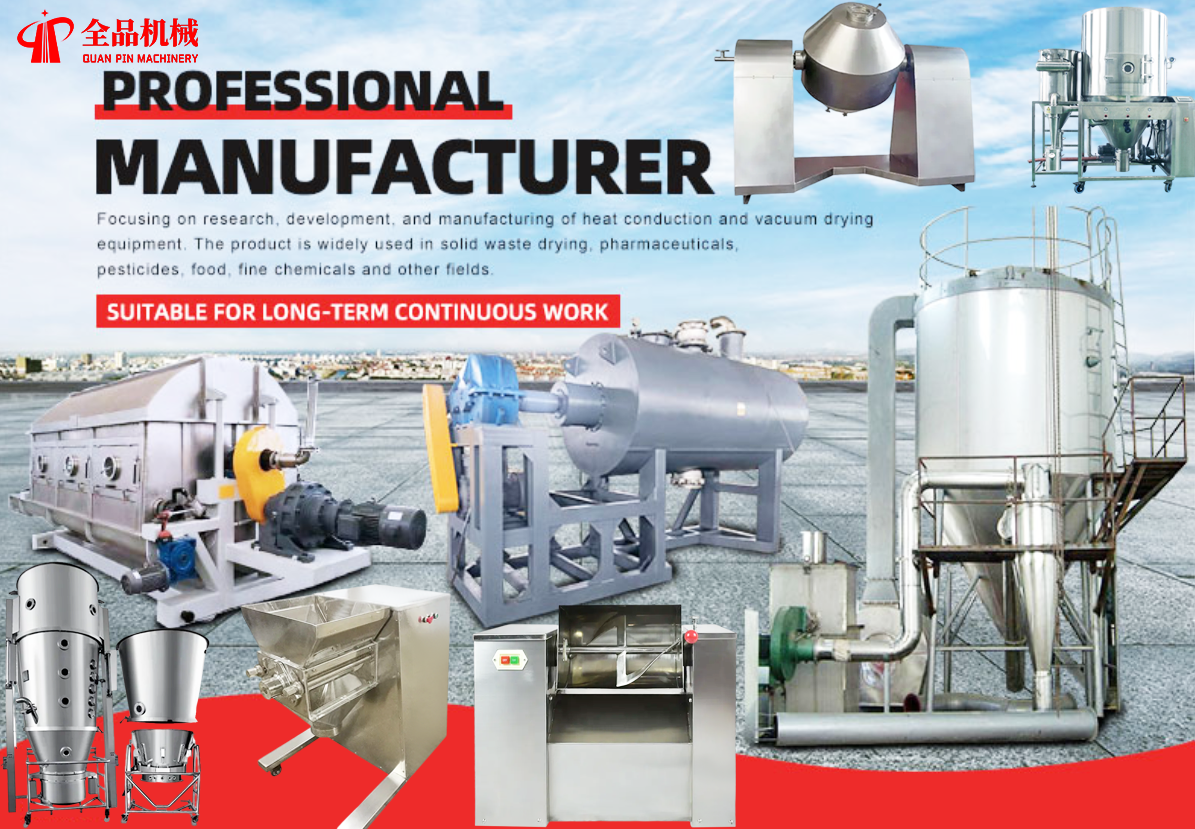
3. Classification of drying equipment
The excess moisture should be removed as much as possible before the material enters the equipment.
● Dryers for solids and pastes.
(1) Disc Dryer.
(2) Screen Transport Dryer.
(3) Rotary Dryer.
(4) Screw Conveyor Dryers.
(5) Overhead dryer.
(6) Agitator Dryer.
(7) Flash Evaporation Dryer.
(8) Drum Dryer.
●The solution and slurry are dried by thermal evaporation.
(1) Drum Dryer.
(2) Spray Dryer.
For process evaluation, consider the vacuum rake dryer for agitated drying under vacuum; the vacuum tray dryer for batch drying on trays under vacuum; the hollow paddle dryer for indirect heat transfer to suitable wet solids; and the hot air circulation oven for batch tray drying with circulating hot air. Confirm suitability with representative material, the required product properties and the proposed process conditions.
YANCHENG QUANPIN MACHINERY CO.. LTD
Sales Manager – Stacie Tang
MP: +86 19850785582
Tel: +86 0515-69038899
E-mail: stacie@qpdryer.com
WhatsAPP: 8615921493205
https://quanpindrying.en.alibaba.com/
Address: Jiangsu Province, China.