Food Paste Mixing: Separate Visible Uniformity from Emulsion Stability
By QUANPIN
A trough mixer trial involving an oil-containing food preparation should distinguish visible uniformity from emulsion stability. An evenly coloured mixture does not independently establish that its dispersed oil droplets will remain unchanged.
The CH equipment discussion concerns a confirmed mixing duty, such as incorporating an already prepared ingredient. The experiments below used specialized emulsification arrangements; they do not demonstrate a CH emulsifying or high-pressure homogenization capability.
Appearance and Stability Answer Different Questions
Visible uniformity is an observation at a stated time and sampling scale. It can identify an obvious unmixed region without establishing the microscopic structure of the dispersed phase.
Emulsion stability concerns changes over time under specified conditions. Droplet association, droplet merging and movement through the continuous phase are different physical responses.
Define the Ingredient and Mixing Duty
Define the ingredient preparation and intended subsequent treatment before selecting a test. A fresh sample, stored sample and heat-exposed sample do not represent the same history.
The proposed S type mixer configuration should be confirmed for the actual material. Neither the presence of oil nor an emulsifier in the recipe establishes the apparatus needed to form the intended droplets.

Five Inputs for an Incorporation Trial
Oil phase
Identify the oil phase and its proportion on a stated basis. Preserve the complete formulation rather than treating every oil-containing paste as one material category.
Stabilizing ingredients
Identify the protein, polysaccharide or other stabilizing ingredients. Their preparation and interactions can influence the resulting dispersion independently of bulk mixing appearance.
Prior preparation
Describe whether the emulsion enters as a prepared ingredient. Keep its earlier homogenization or other processing distinguishable from the proposed incorporation stage.
Measurement method
Specify the microscopic and macroscopic observations. Droplet-size measurements, imaging and phase-separation observations answer complementary questions.
Represented conditions
State the storage or processing conditions represented by the stability assessment. An immediate visual check cannot supply an unmeasured time-dependent result.
Retain the Formulation Boundary
An original pea-protein formulation experiment varied maltodextrin, gum arabic and pea protein and measured droplet dimensions and creaming stability separately.
Changing the formulation changed both responses in that laboratory system. Its findings support retaining ingredient identity, rather than assigning every observed improvement to longer bulk mixing.
The emulsions were prepared with specialized laboratory processing. Their droplet results are not specifications or validated outcomes for a CH powder and paste mixer.
When incorporation is the proposed duty, assess whether the prepared ingredient remains suitable after that actual stage. Do not silently turn an incorporation proposal into a claim of fine-emulsion production.

Six Stages Connecting Preparation and Results
Before mixing
Before mixing, document the prepared ingredient and its prior processing. Preserve a suitable reference for comparison with material after incorporation.
During incorporation
During incorporation, retain the actual formulation and sequence. Changes in ingredient preparation should remain distinguishable from changes in the proposed mixing conditions.
During sampling
During sampling, identify the represented position and stage. A useful visual specimen and a specimen for droplet characterization need clear identities.
During microscopy
During microscopic assessment, retain the preparation method. Diluting or otherwise preparing a specimen can alter the associations being investigated.
During the stability test
During storage or another challenge, state the conditions and observation times. The result should remain connected to the sample history actually examined.
During interpretation
During interpretation, distinguish bulk appearance, droplet observations and separation. A favourable result for one attribute does not independently establish the other attributes.
Read Distinct Stability Measurements
Separate optical and rheological evidence
Physical stability is not one universal number. Different measurements can reveal different changes within the same formulation.
An original whey-protein and chitosan experiment examined rapeseed-oil dispersions using imaging, rheology and observations during storage.
It used high-energy emulsification and an antimicrobial-preserved laboratory model. Its storage observations are not a food recipe, microbial-safety demonstration or shelf-life guarantee for a production paste.
Examine interfacial preparation
An ingredient’s interfacial preparation can influence behaviour even when initial droplets have broadly comparable dimensions.
An original whey-protein nanogel investigation compared protein preparations while examining interface coverage, droplet dimensions and responses to temperature, pH and cold storage.
The nanogel and untreated-protein emulsions had comparable initial droplet dimensions but different interfacial observations and stability responses. Similar initial size therefore did not settle the complete assessment.
Keep stability mechanisms distinct
Creaming and droplet coalescence also require distinct interpretations. A formulation can change the rate of phase movement without supplying the same change in every other stability measure.
An original whey-protein microgel and xanthan study assessed droplet dimensions, physical stability and oxidation separately. Protein preparation and gum addition influenced different mechanisms.
Its results illustrate why physical and oxidative stability should not be renamed as one interchangeable outcome. The experimental pretreatment is not an assumed CH mixer function.
Compare the Actual Incorporation Stage
A useful incorporation trial retains a reference prepared ingredient and a specimen after the proposed mixing stage. Apply the same analytical preparation when comparing them.
If the concern is microscopic structure, select a suitable method with the laboratory. A photograph of the vessel cannot establish the represented droplet distribution.
If the concern is separation over time, state the conditions and duration of the test. Avoid extending a short observation into a claim about the entire intended storage period.
If another processing step follows mixing, keep it explicit. Heating, drying or other treatment can create a different question from immediate incorporation uniformity.
Keep Later Processing Separate
An original byproduct-stabilized flavour-emulsion investigation assessed prepared oil-in-water emulsions before spray drying and subsequently evaluated the resulting powders.
Its separate stages show why an emulsion observation and a dried-powder observation need their own evidence. This discussion does not assign spray-drying capability or flavour-retention performance to CH equipment.
Investigate Conflicting Observations
If a sample looks uniform but later separates, preserve both observations. The initial visual result and subsequent stability response describe different aspects of the preparation.
If droplet dimensions remain similar while separation changes, consider the continuous phase and droplet associations with the laboratory. The difference is not automatically an analytical error.
If a gum changes viscosity, measure the relevant stability response rather than treating thickness alone as proof of a stable dispersion.
If a protein pretreatment changes the result, retain that preparation in the conclusion. A formulation change cannot be attributed entirely to the bulk mixing stage.
If an emulsion passes one temperature or pH assessment, do not assume it passes every later treatment. Results remain conditional on what was examined.
If physical stability improves, do not infer microbial safety or oxidative stability. These are separate questions with their own evidence requirements.

Prepare the Food-Paste Enquiry
For a powder and paste mixer enquiry, describe whether a prepared emulsion is incorporated and what the final mixture must demonstrate. State the separate appearance and stability objectives.
Identify the reference specimens, laboratory measurements and later processing stages. Confirm which activities are included in the equipment trial and which occur separately.
Confirm the CH Supply Scope
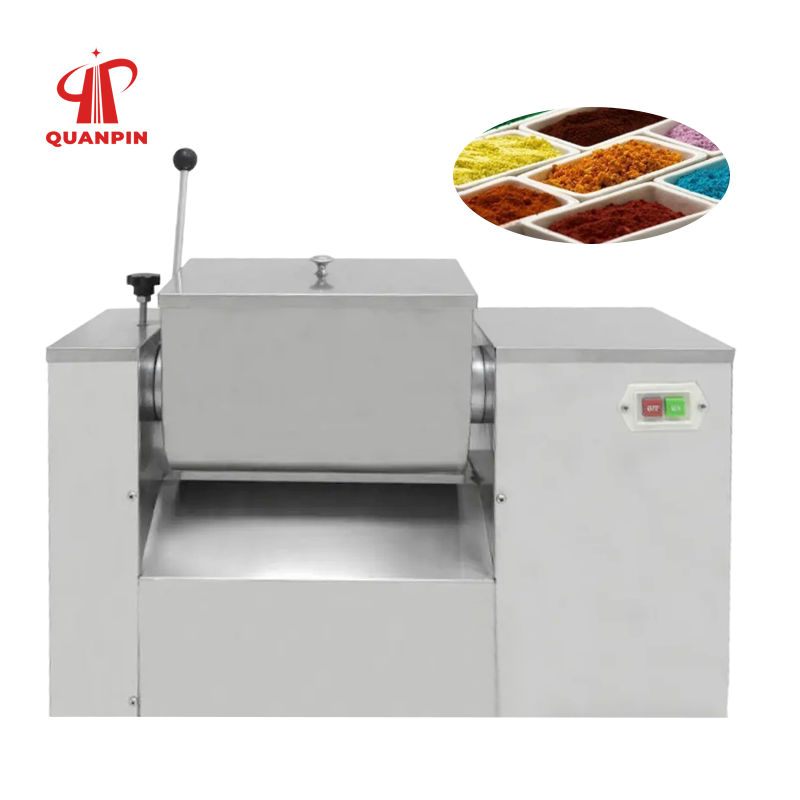
Review the QUANPIN CH equipment information against the actual incorporation duty. Suitability and supplied features require confirmation for the proposed food formulation.
A trough mixer manufacturer proposal should distinguish bulk mixing from specialized emulsification. Its quotation cannot guarantee an untested droplet distribution, storage response or finished-food shelf life.
Frequently Asked Questions
Does uniform colour prove stability?
No. An evenly coloured sample is a bulk observation at a particular time. It does not independently establish microscopic droplet structure or its subsequent stability.
Does one droplet result describe everything?
No. Droplet size, association and movement through the continuous phase can contribute differently. Preserve the measured attribute rather than using one result as a substitute for all others.
Does CH automatically provide emulsification?
No. The research used specific emulsification and ingredient-preparation arrangements. These capabilities are not implied by a CH mixing proposal.
Does thickness prove stability?
No. Viscosity and a measured stability response are related formulation properties, but a thick-looking sample does not independently demonstrate the required storage behaviour.
Does physical stability establish safety?
No. Physical appearance or dispersion stability does not establish microbial safety, oxidative stability or suitability throughout a proposed shelf life.
What should the enquiry describe?
Provide formulation identity, prior emulsion preparation, incorporation duty, measurement methods and subsequent conditions. Define what the representative CH trial should establish and what remains separate.
Discuss Your Food-Paste Mixing Duty
Discuss the material, processing objective and required trials with QUANPIN. Review the equipment information and the relevant industry applications, or send an enquiry through our contact page.
Email sales@qpdryer.com or stacie@qpdryer.com. Call +86 19850785582 or contact WhatsApp +86 15921493205 to discuss the proposed scope.
For process evaluation, consider the pharmaceutical trough mixer for batch mixing of suitable powders or pastes; and the ribbon blender for ribbon-driven mixing of suitable powder batches. Confirm suitability with representative material, the required product properties and the proposed process conditions.