Protein Spray Drying: Distinguish Particle Surface Composition from Molecular Aggregation
By QUANPIN
A dairy powder can have a protein-rich surface without a measured increase in molecular aggregates. Conversely, a bulk protein change need not produce an obvious change in particle appearance. These are different questions requiring different specimens and analytical methods.
For a centrifugal spray dryer, establish whether the investigation concerns surface composition, protein association or particle cohesion before changing operating conditions. This guide addresses that analytical distinction for food ingredients, rather than solids recovery or foam after reconstitution.
What Does a Protein-Rich Surface Establish?
Surface composition describes the material detected near the outside of a particle. Bulk composition describes the whole sample. Differences between these measurements can reveal component segregation, provided the analytical depth and calculation assumptions are stated.
Protein aggregation concerns association between protein molecules. A surface nitrogen signal, a wrinkled particle or a lump of powder does not independently establish that association. Each observation belongs to a separate measurement scale.
How Does the LPG Process Relate to This Question?
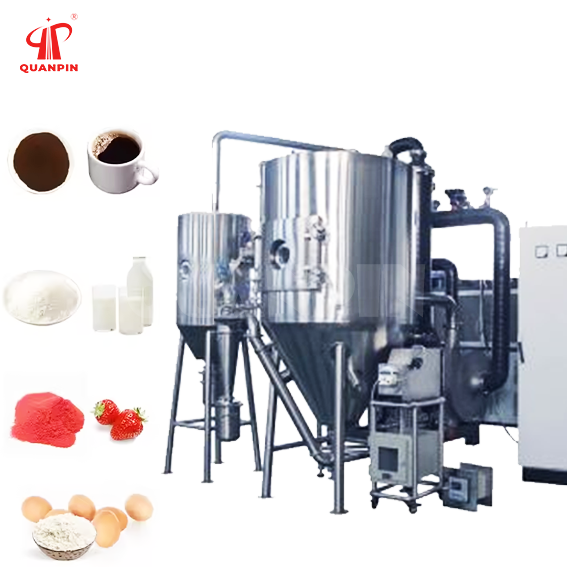
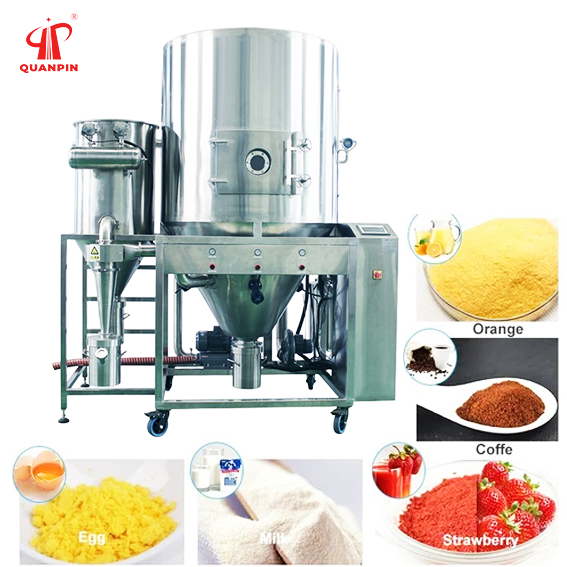
The QUANPIN LPG high speed centrifugal spray dryer atomizes a suitable liquid feed and removes water through contact with drying gas. Its equipment selection still requires representative feed and a defined powder specification.
A centrifugal spray dryer for milk powder may process a multicomponent formulation. Fat, sugars and protein can redistribute during droplet formation and drying. No universal surface composition or protein response is promised for every dairy feed.
Which Five Inputs Make the Comparison Interpretable?
Formulation
Record protein source and concentration alongside lactose, fat and other ingredients. A surface analysis interpreted as protein coverage becomes harder to compare when the underlying formulation also changes.
Feed history
Describe heating, homogenization, pH adjustment and holding before atomization. Otherwise, an upstream change may be attributed to the dryer merely because the powder is where it becomes visible.
Surface method
Specify the surface method, specimen preparation and reporting basis. An elemental measurement translated into ingredient fractions depends on a compositional model; document that model rather than treating the conversion as direct protein identification.
Bulk protein method
Select a bulk protein method appropriate to the question. State extraction conditions and whether the result describes soluble material, insoluble material or a specific molecular fraction.
Particle observations
Keep a particle-level observation alongside molecular evidence, without merging them. Microscopy can describe shape and contacts; an agreed protein assay must establish the associated molecular question.
What Does Particle Morphology Contribute?
In a milk serum protein and lactose study, milk serum protein/lactose formulations showed relationships between feed surface properties and spray-dried particle morphology. Higher protein formulations developed different surface deformation from low-protein formulations in that experiment.
The investigators discussed surface pressure and elasticity as contributors under their conditions. This supports measuring the feed interface when interpreting particle shape; it does not make shape a quantitative assay of aggregated protein.
For a centrifugal spray dryer for whey protein, retain a feed aliquot and a representative collected powder sample. Compare like formulation histories rather than substituting a different protein concentration for the process comparison.
If shape changes while the chosen protein assay remains stable, report that divergence. A useful result can narrow the mechanism without producing a single simplified quality score.
Which Six Stages Need Separate Records?
Formulation preparation
Separate formulation changes from process changes. Adding a surface-active component creates a new comparison even when the nominal protein concentration remains unchanged.
Atomization
Record the atomization arrangement and feed delivery conditions. Droplet formation is a physical event preceding most of the water removal and can contribute to segregation.
Drying
Record the drying conditions relevant to the trial, including the actual measurement locations. Avoid substituting one air temperature for a complete description of protein exposure.
Collection
Define where powder was collected. Different collection fractions or wall deposits should not silently become interchangeable specimens in a surface comparison.
Reconstitution
Standardize any reconstitution before a bulk assay. Water composition, mixing and waiting time can change what enters the measured soluble fraction.
Storage
Preserve storage history. Analyze paired specimens at comparable ages and document packaging and moisture exposure before interpreting a difference as an atomization effect.
How Should Three Measurement Scales Be Compared?
Segregation during atomization
an original atomization study provides an important counterpoint to a drying-only explanation. The researchers flash-froze droplets immediately after atomization and compared them with dried particles from model milk systems.
Their surface and microscopy observations supported fat-rich surfaces established during atomization, with protein accumulating underneath during subsequent drying. Their proposed mechanism involved disruption along fat-globule interfaces.
That result cautions against assuming every surface change is caused solely by competitive adsorption during evaporation. It is original model-milk evidence, not a universal mechanism for every food protein formulation.
Bulk molecular association
A bulk aggregation measurement answers a different question from that droplet experiment. Define the protein fraction being recovered and distinguish a change in extraction from a change in molecular association.
Where multiple methods disagree, inspect specimen preparation first. Loss of poorly dispersed material before analysis can produce a different analytical population from the original powder.
Report the method-specific result with its uncertainty and limitations. Calling every difference heat damage would obscure the information needed to select the next experiment.
Particle cohesion
Particle cohesion is a third scale. Contacts between powder particles can produce clumps while leaving the state of individual protein molecules unresolved.
Likewise, a surface enriched in one ingredient need not have the same composition as an internal region. Keep surface and whole-powder results in separate data fields.
A comparison becomes more informative when these scales are measured independently. The objective is to identify which observation changed, not to force all measurements into agreement.
What Can a Formulation Additive Change?
a food hydrolysate encapsulation study examined food protein hydrolysate encapsulation using Arabic gum, with formulation additives including Tween 20 and pullulan. The spray-dried preparations without additives had higher surface nitrogen in that study.
The authors attributed this mainly to the absence of Tween 20 and discussed possible degradation of surface-exposed peptides. This is formulation-specific evidence, not proof that an additive always prevents protein aggregation.
The paper also compared electrospraying and assessed inhibitory activity in vitro. Neither electrospraying capability nor a human health benefit is claimed here for QUANPIN equipment.
For a dairy enquiry, transfer the experimental question rather than the recipe: does the formulation change the outer surface, and which independent test evaluates the protein property actually required?
How Does Powder Stickiness Differ?
an original whey powder stickiness study compared physical stickiness measurements in model whey protein powders using dynamic mechanical analysis alongside other techniques. The correspondence between measurements depended on the powder composition.
These physical responses should not be relabeled molecular aggregation. A powder handling problem and a change in protein molecular state can coexist, but one measurement does not establish both.
Where Do Chemical Markers Fit?
Chemical modification needs its own evidence as well. a milk matrix Maillard experiment investigated Maillard reactions in a milk protein matrix using markers including free amino groups and hydroxymethylfurfural under drying and storage comparisons.
The study included electrostatic spray drying, conventional spray drying and freeze drying. These are research comparisons; they do not imply that an LPG centrifugal machine provides the other processing routes.
A chemical marker can change without establishing the amount or type of protein aggregate. Similarly, a bulk aggregate result cannot identify every chemical modification responsible for it.
Keep storage temperature and water activity with the marker results. A later storage reaction must not automatically be assigned to the short drying stage.
Select the chemical assay because it answers a defined question. Avoid adding a familiar marker merely to give a surface composition report an appearance of completeness.
Together, surface, molecular, physical and chemical measurements provide complementary evidence. Agreement can strengthen an interpretation; disagreement identifies where further investigation is needed.
What Should the Equipment Enquiry Specify?
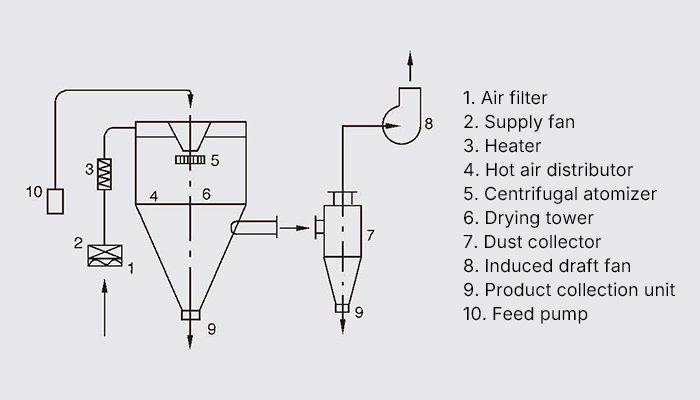
A centrifugal spray dryer working principle explains atomization and evaporation, but an equipment quotation should also define what specimens will support the requested analytical comparison.
Send the formulation, upstream history, required capacity and intended food use. State whether the purchasing concern is surface composition or a separately specified protein property, and request an appropriate trial scope.
Which Records Make the Evidence Traceable?
Retain sample identifiers linking feed, collected fraction, storage and laboratory preparation. Photographs are useful supporting records but cannot replace the analytical results.
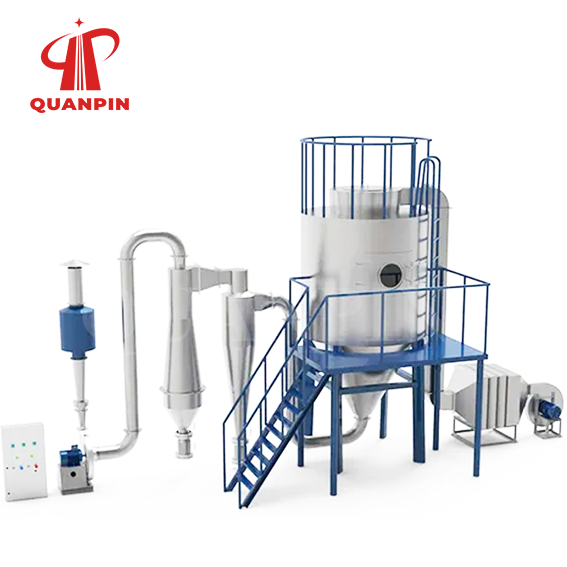
Report research findings separately from project observations. The equipment images illustrate QUANPIN references; none of the cited experiments is presented as a QUANPIN customer trial or guaranteed outcome.
Frequently Asked Questions
Does surface nitrogen measure aggregates?
No. Surface nitrogen is an elemental observation near the particle exterior. It requires a stated interpretation model and does not independently measure molecular protein aggregates.
Do wrinkles prove protein aggregation?
No. Particle wrinkles describe morphology. Feed surface properties may contribute, while a suitable bulk protein assay is needed to investigate molecular association.
Does segregation begin only during drying?
Not necessarily. Original model-milk research demonstrated a contribution from atomization itself. The relevant mechanism depends on the formulation and experimental evidence.
Are powder clumps protein aggregates?
No. Powder particles can adhere through physical mechanisms without that observation establishing the molecular state of their protein. Specify separate handling and protein tests.
Does Tween 20 suit every protein formulation?
No. The hydrolysate study concerned a particular encapsulation formulation. It supports testing formulation effects, not transferring an additive recommendation to every dairy ingredient.
Can published studies replace a material trial?
No. Published studies help define the questions and methods. Equipment suitability and powder acceptance require representative material, agreed measurements and project-specific evidence.
Discuss Your Food Protein Drying Requirements
Discuss the material, processing objective and required trials with QUANPIN. Review the equipment information and the relevant industry applications, or send an enquiry through our contact page.
Email sales@qpdryer.com or stacie@qpdryer.com. Call +86 19850785582 or contact WhatsApp +86 15921493205 to discuss the proposed scope.
For process evaluation, consider the centrifugal spray dryer machine for centrifugal atomization of suitable liquid feeds. Confirm suitability with representative material, the required product properties and the proposed process conditions.