Ribbon Blender Research: Distinguish Simulation Predictions from Validated Seasoning Trials
By QUANPIN
A ribbon blender simulation can help investigate a specific powder-flow question. Its coloured particle map remains a calculated result, however, and needs a different interpretation from a measured seasoning trial.
For food-seasoning development, distinguish what the model represents, what it predicts and which physical observations test that prediction. A persuasive animation alone does not demonstrate production blend performance.
Define What a Model Is Intended to Predict
Begin with the intended prediction. Particle trajectories, local concentration and final collected composition are different outputs; choose the quantity needed for the actual decision.
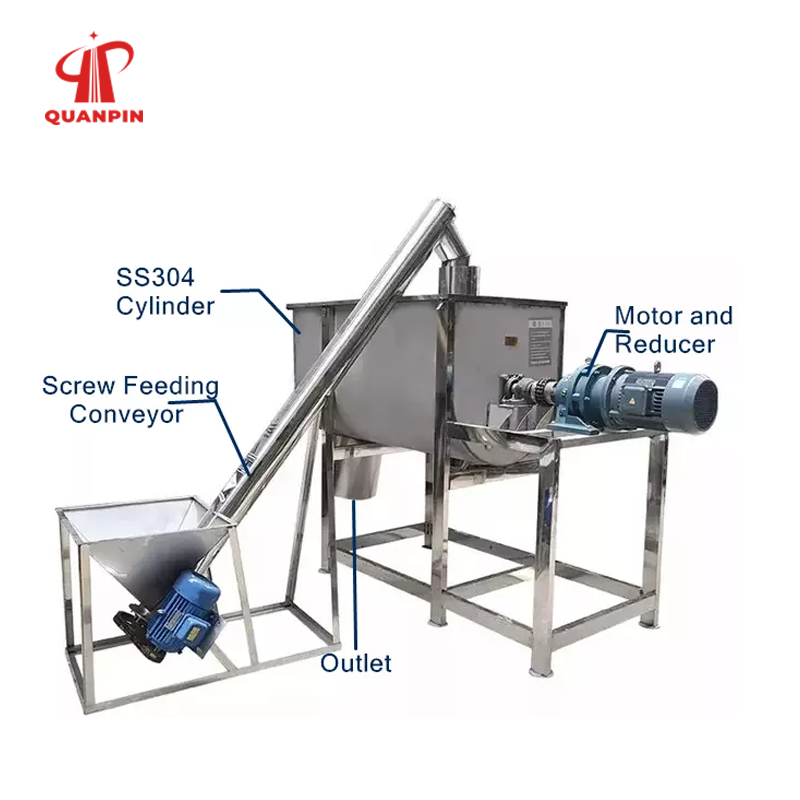
Specify whether the research concerns movement inside a mixer or a separate receiving operation. Evidence for one geometry cannot validate every operation in a complete processing line.
Separate Numerical Representation from Equipment
A numerical representation simplifies a physical system. Describe which material features are represented and which are excluded before treating its output as evidence for a spice formulation.
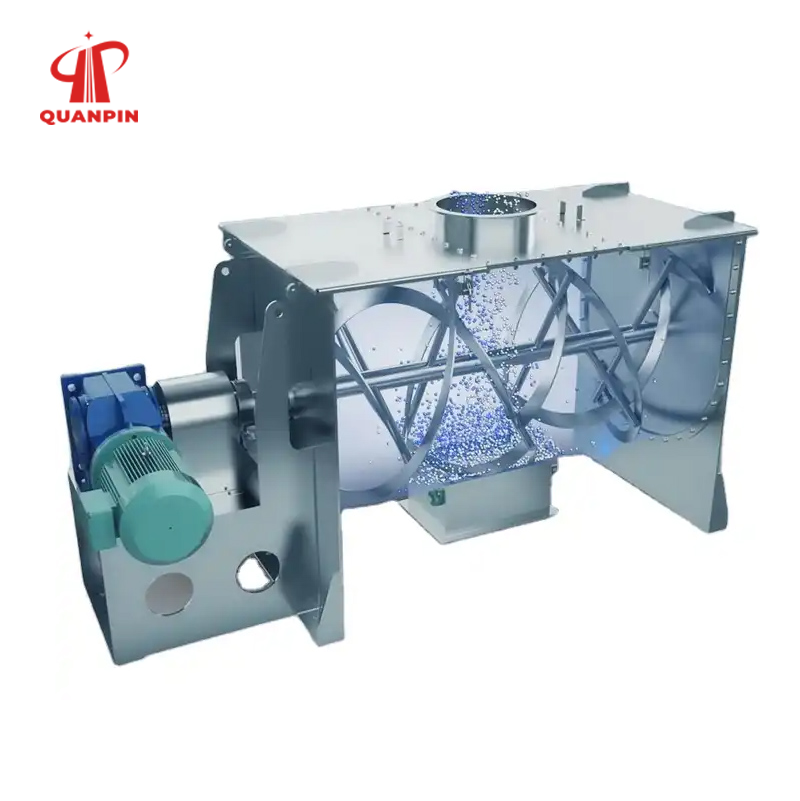
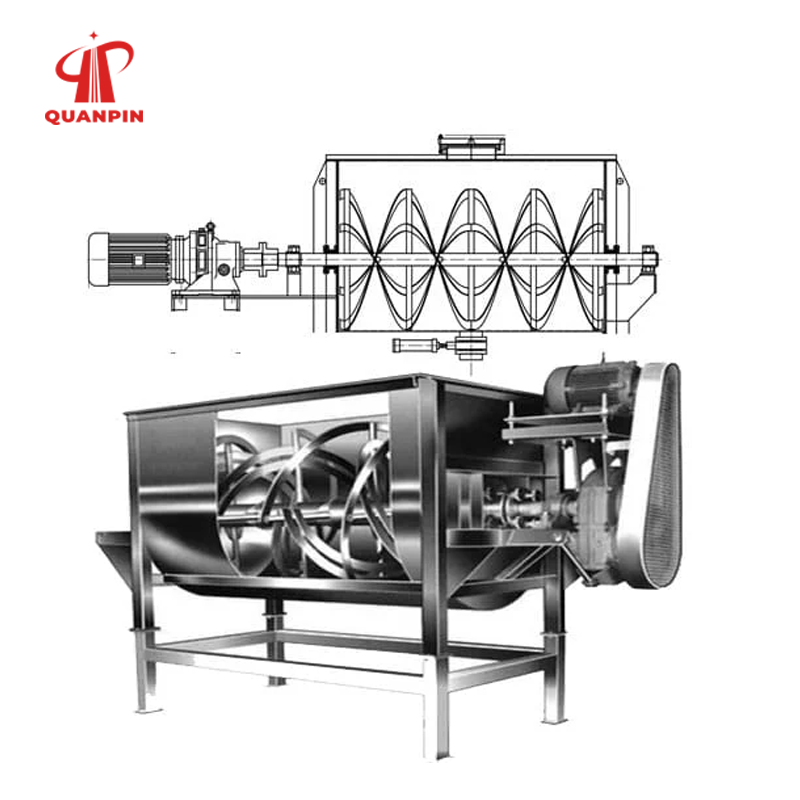
An industrial ribbon blender enquiry still requires confirmed equipment information. A published computational vessel is not a drawing of the proposed QUANPIN machine.
Record Five Model-Comparison Inputs
Prediction objective
Record the prediction objective and the observable that could test it. A model of local segregation should not silently become a prediction of every packaged product.
Material representation
Identify the represented particles and their properties. Model beads or two idealized populations do not independently describe irregular, cohesive, multicomponent seasoning powders.
Geometry representation
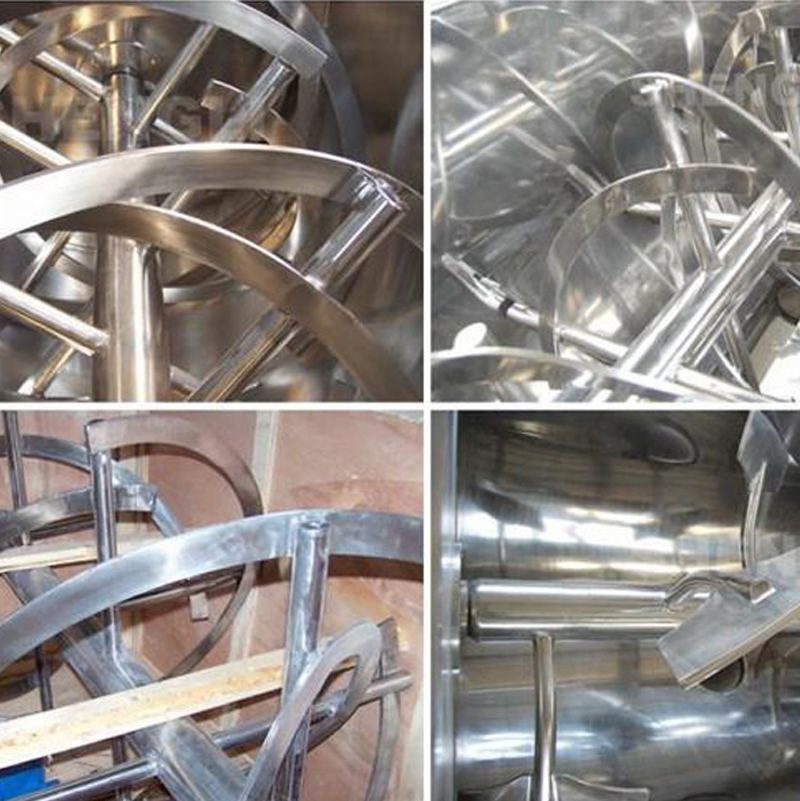
Identify the actual computational geometry. Trough shape, movement boundaries and an attached hopper belong to different parts of the representation.
Boundary conditions
Describe imposed initial and boundary conditions. A prescribed inlet concentration or flow history may be an assumption rather than a result predicted by the model.
Validation observations
Identify the physical measurements used for comparison. Their material, apparatus and operating range define the available validation evidence.
Use Physical Ribbon Experiments as a Reference
A physical laboratory ribbon experiment provides a useful contrast with computational work: its homogeneity observations came from actual prepared mixtures and a defined apparatus.
That experiment used lactose, ascorbic acid and zinc oxide. Its findings cannot be presented as measurements of a food seasoning or a QUANPIN horizontal ribbon mixer.
The original ribbon-mixer experiment examined operational parameters and feed preparation. It shows why an experimental reference must retain its material and preparation conditions.
Use physical observations to frame a testable question for a calculation. Do not describe an attractive model trend as experimentally confirmed merely because another powder-mixing experiment exists.
Follow Six Model-Review Boundaries
State the physical question
State the physical question before selecting a model. Predicting transport, local segregation and overall mixing can require different representations and different observations.
Identify the model class
Identify whether the study follows individual simulated particles or treats a mixture as continuous fields. These approaches produce quantities at different descriptive levels.
Document assumptions
Document the assumptions relevant to the proposed seasoning. Excluded cohesion, simplified shape or idealized ingredient populations can limit a conclusion even when calculations are repeatable.
Check numerical outputs
Check what each displayed numerical output means. A plotted concentration field and a physical assay result need compatible definitions before their agreement can be assessed.
Compare physical measurements
Compare the prediction with identified physical measurements. Preserve the observation locations and material condition rather than comparing unrelated averages.
Define the applicability limit
State the applicability limit after comparison. Agreement within one apparatus and tested material range does not establish a universal mixer-selection rule.
Compare Predicted and Measured Quantities
Match the quantity
For a ribbon powder mixer study, ask whether the proposed calculation addresses the actual technical uncertainty. A model can be useful without answering every purchasing question.
Separate inputs selected to reproduce observations from observations reserved to assess predictive performance. Reproducing fitted information offers a different test from predicting an additional condition.
State this distinction in the report even when the original research uses a different development workflow. Do not imply that an independent validation was performed without evidence.
Separate fitting from checking
Match the reported quantity: compare a local concentration with a corresponding location, or an overall statistic with an equivalently defined physical statistic.
Keep fitted parameters and comparison conditions available for review. A final plot without its assumptions may conceal why the apparent agreement occurs.
Retain disagreement. It can reveal a limitation in material representation, boundary information or physical measurement, rather than proving that the equipment itself is unsuitable.
Retain disagreement
An original bidisperse-mixture model investigated simultaneous size and density differences. Its represented populations illustrate a deliberately simplified material system.
Use that study to discuss assumptions and model scope. It does not establish that two particle types represent all components of a seasoning recipe.
A boundary condition can change with time. A constant feeding assumption should not silently represent an actual interrupted or varying transfer.
Interpret Simplified Particle Populations
The periodically driven heap-flow study investigated a time-dependent receiving flow. Its relevance here is the explicit relationship between imposed feeding history and modelled deposit structure.
That apparatus is a heap, not a ribbon mixer. It provides a separate example of boundary-condition sensitivity without validating a numerical mixer model.
A combined continuum segregation study used a finite-element flow description with an advection-diffusion-segregation equation. Its predicted fields require interpretation in that mathematical framework.
The study compared granular results for particular apparatus. Neither its mathematical formulation nor its comparisons establish a verified food-seasoning prediction for another machine.
Examine Time-Dependent Boundary Conditions
Purdue’s original hopper-discharge investigation combined physical experiments and particle simulations. Keeping both forms of evidence identifiable is useful when judging what was actually tested.
Its glass-bead hopper research remains distinct from a ribbon-mixing trial. Transfer of a method requires a justified material and geometry comparison, not just a shared powder-processing label.
Evaluate Validation beyond One Apparatus
If predictions and measurements disagree, first check that they describe the same quantity and condition. A mismatch in the comparison basis can resemble a failed physical model.
Then review the assumptions relevant to the observed difference. Avoid adjusting several material and boundary inputs together without documenting what each change is intended to explain.
Prepare a ribbon mixer enquiry with the actual seasoning duty and available experimental observations. Explain the uncertainty a numerical study is expected to resolve.
Ask QUANPIN to confirm the proposed physical configuration. Do not substitute dimensions or capabilities from a published research apparatus for supplier-confirmed information.
Specify who will supply material characterization, develop any calculation and perform physical testing. These are distinct responsibilities and may require different technical specialists.
Retain food-handling, cleaning and allergen requirements in the equipment review. Numerical agreement on a mixing quantity does not demonstrate those separate requirements.
Prepare a Model-Supported Equipment Enquiry
Label numerical predictions, physical observations and interpretations separately in the trial account. Readers should be able to trace each conclusion to its actual evidence.
A useful computational contribution makes assumptions and remaining tests visible. It does not remove the need to evaluate the proposed material and equipment together.
Keep Predictions Identifiable
Discuss the intended seasoning application with QUANPIN using the verified equipment and contact links below. Explain which measured product attributes the trial must address.
Keep numerical evidence useful by keeping its scope explicit. The practical objective is an interpretable equipment decision, supported by suitable physical observations.
Frequently Asked Questions
Does a simulated result prove production performance?
No. A calculation describes its represented system and assumptions. Production performance requires suitable evidence for the actual material, equipment and operating range.
Are DEM and continuum models interchangeable?
No. Discrete-particle and continuum approaches describe the system differently. Their outputs and assumptions need method-specific interpretation before comparison.
Can a hopper model validate a ribbon mixer?
No. A hopper-discharge comparison validates only the stated study scope. It does not independently validate movement or ingredient distribution inside a ribbon vessel.
Does calibration replace validation?
No. Adjusting a model to reproduce data and checking a prediction against further observations answer different questions. Report what was actually performed.
Can model settings specify QUANPIN equipment?
No. Published model inputs belong to the studied representation. Confirm the physical configuration with QUANPIN and assess the proposed application independently.
What should a model-supported enquiry include?
Include the material description, physical configuration, prediction objective, assumptions and available comparison measurements. Identify unresolved differences and required physical trials.
Discuss Your Seasoning-Trial Evidence
Discuss the QUANPIN WLDH horizontal ribbon mixer with QUANPIN. Use our contact page or the enquiry form to explain the intended material-processing application.
Email sales@qpdryer.com or stacie@qpdryer.com. Call +86 19850785582, or contact us on WhatsApp: +86 15921493205.