Working Principle of KJG Paddle Drying Equipment
The working principle of KJG paddle drying equipment centers on simultaneous conduction heating through the jacket and hollow paddles, self-cleaning wedge surfaces that maintain heat transfer, and low-speed agitation that promotes plug flow:
- W-shaped jacketed shell holds the material: The horizontal W-shaped shell is jacketed, and wet material is continuously fed into the shell through the inlet.
- Hollow shaft and wedge-shaped paddles transfer heat: Wedge-shaped hollow paddles are densely arranged on the hollow shaft; the paddles serve both as agitators and as heat transfer surfaces.
- Heating medium fed simultaneously through two paths: Steam or thermal oil passes through a rotary joint and flows simultaneously through the shell jacket and the interior of the hollow paddles.
- Indirect conduction heating of the material: Heat is transferred directly to the material through the jacket wall and paddle walls, with no carrier gas carrying heat away and low heat loss.
- Low-speed paddle rotation and agitation: The hollow shaft rotates at low speed, and the paddles agitate the material into full contact with the hot surfaces, usually below 4 r/min.
- Inclined surfaces make particles slide off and renew the hot surface: The heat transfer side of the paddle is inclined; particles contacting the incline quickly slide away with rotation, continuously renewing the heated surface.
- Relative motion of wedge surfaces provides self-cleaning: The relative motion between material particles and the wedge surfaces produces a scrubbing action that removes adhering material and keeps the heat transfer surface clean during operation.
- Compression–relaxation action enhances heat transfer: The compression–expansion agitation of the wedge-shaped paddles makes material particles repeatedly approach and leave the hot surface, enhancing heat transfer contact.
- Material advances axially in plug flow: The paddles have a certain axial angle, so the material moves from the feed inlet to the discharge outlet essentially in plug flow, with little back-mixing.
- Adjustable residence time ensures uniform moisture: Residence time is adjusted through feed rate and rotation speed, giving a narrow distribution and consistent discharge moisture between batches.
- A small amount of gas or nitrogen carries out moisture: Vaporized moisture is carried out by a small amount of gas; for solvents or easily oxidized conditions, nitrogen closed-loop circulation is used instead.
- Closed shell prevents dust and leakage: The shell is provided with sealed end covers and a top cover; the drying process uses little gas at low velocity, resulting in low dust entrainment and environmental pollution.
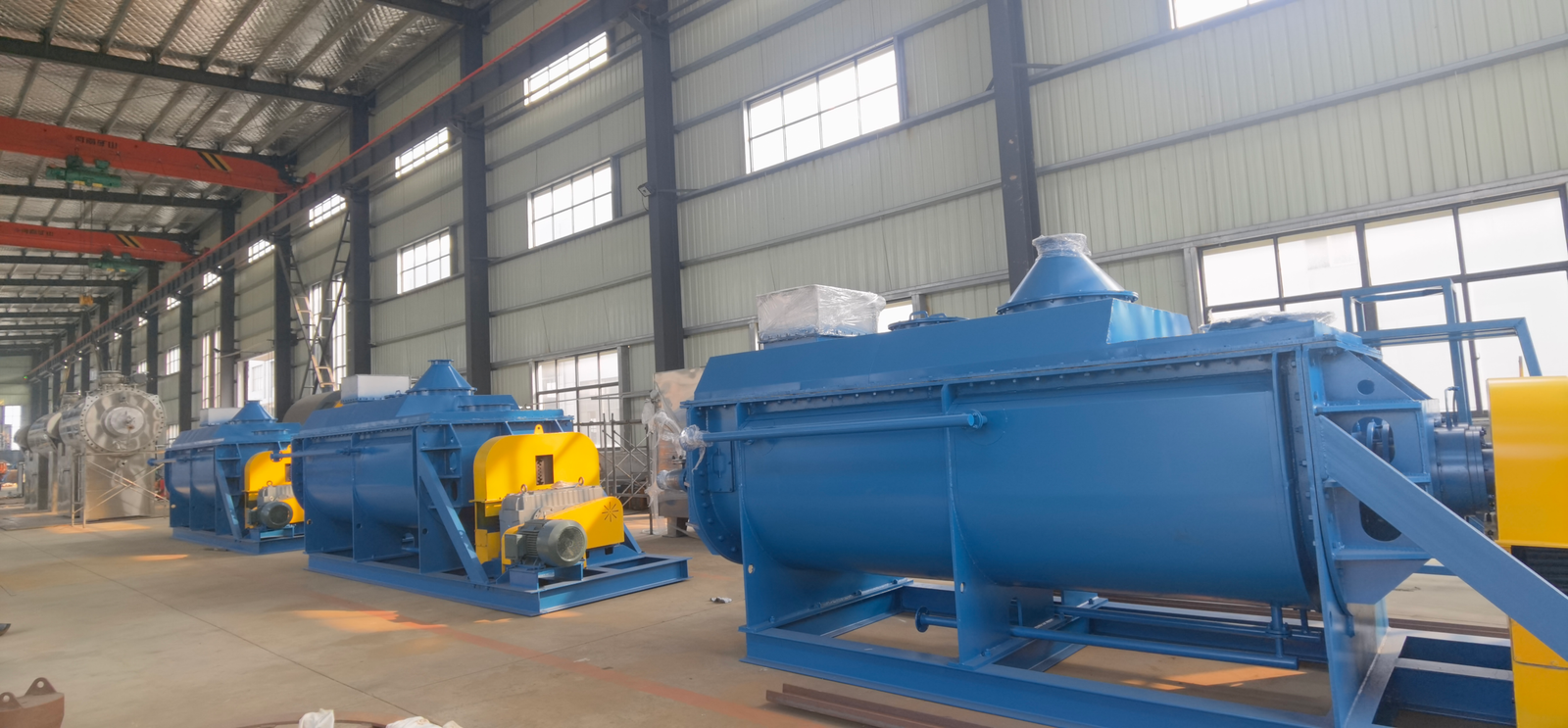
For process evaluation, consider the hollow paddle dryer for indirect heat transfer to suitable wet solids; the continuous disc dryer for indirect drying across heated disc surfaces; the drum scraper dryer for drying a suitable feed as a thin layer on a heated drum; and the vacuum rake dryer for agitated drying under vacuum. Confirm suitability with representative material, the required product properties and the proposed process conditions.
YANCHENG QUANPIN MACHINERY CO.. LTD
Sales Manager – Stacie Tang
MP: +86 19850785582
Tel: +86 0515-69038899
E-mail: stacie@qpdryer.com
WhatsAPP: 8615921493205
https://quanpindrying.en.alibaba.com/
Address: Jiangsu Province, China.