WFJ Milling Trials: Trace Electrostatic Charging through Powder Transfer
By QUANPIN
A pharmaceutical milling trial should identify the contacts that powder experiences before its electrostatic behaviour is interpreted. Size reduction, transfer and sample handling can all change the material history.
An air classifier mill enquiry therefore benefits from a description of the complete receiving and collection route. A particle-size result alone does not describe electrical charge on the collected powder.
Describe the Complete Contact History
Begin with the actual ingredient or formulation, its lot identity and the purpose of the trial. Keep a development specimen distinguishable from production material.
Mark the boundaries between the proposed mill, external transfer equipment and laboratory preparation. Each boundary can introduce contact with a different surface or container.
Separate Three Measurement Questions
Particle-size analysis describes a distribution under the selected analytical method. Charge measurement addresses a separate property under its own collection and measurement conditions.
Powder-transfer performance is another observation. Interrupted discharge or material remaining on a surface warrants investigation, but neither observation identifies its cause without additional evidence.
Record Five Trial Inputs
Material identity
Record the formulation revision and material lot. A familiar ingredient name does not establish identical surface condition or charging behaviour across specimens.
Incoming condition
Describe relevant conditioning and storage observations. Record measured environmental conditions where the approved study requires them; do not substitute an assumed universal humidity setting.
Contact surfaces
Identify powder-contact materials along the agreed route. Include transfer containers and sample vessels, not simply the principal machine housing.
Transfer sequence
Record the actual sequence of transfers and any interruption. An additional pouring step can make two otherwise similar test histories different.
Sampling point
Specify where a specimen is collected and who measures it. Keep the collection location identifiable when size and charge measurements use separate specimens.
Read Contact-Charging Evidence Carefully
Original pharmaceutical research compared laboratory contact measurements with twin-screw feeding. Similar material rankings did not produce identical charge magnitudes, and one material showed a polarity difference between arrangements. See research comparing pharmaceutical charging in two processes.
That comparison supports retaining the test arrangement with the result. It does not validate a laboratory value as the charge expected from a QUANPIN machine.
Original pharmaceutical-powder experiments used a modified annular shear cell to examine charge generation in lactose. Increasing applied shear strain increased charge in that model system. See university research on shear-induced powder charging.
Use this evidence to frame questions about contacts and measurement. Neither study establishes an operating limit, a production charging guarantee or an equipment modification for the proposed installation.
Follow Six Material-Handling Boundaries
Feed preparation
Before feed preparation, preserve the material identity and approved handling requirements. Avoid introducing a different formulation merely because it transfers more conveniently.
Charging interface
At the charging interface, describe the actual receiving connection. Ask the supplier to confirm which parts belong to the supplied configuration.
Milling operation
During milling, retain the recorded operating arrangement within the authorised trial scope. The term air classifying mill does not itself establish an antistatic feature.
Powder collection
At collection, identify the receiving vessel and the material actually recovered. Keep collection observations separate from assumptions about the cause of adhesion.
Sample transfer
During sample transfer, record additional containers and handling. A laboratory specimen may have a different contact history from powder remaining in the process receiver.
Laboratory measurement
At measurement, retain the method, specimen identity and timing. A number without its measurement basis cannot support a reliable comparison.
Design a Meaningful Comparison
Keep the method consistent
For an ACM mill comparison, decide which question the trial will answer. Comparing charge, size distribution and transfer behaviour requires distinct observations connected to the same documented conditions.
Where feasible, retain the same collection procedure between trials. If a different method is necessary, report the change before comparing numerical results.
Research on cellulose ethers and their mixtures with flurbiprofen examined charging and surface adhesion using controlled shaking tests. Material attributes and formulation composition were part of the investigation. See original pharmaceutical charging and adhesion experiments.
Preserve the actual sequence
Those observations demonstrate that the contacting surface can matter. They do not justify deliberately charging production material or selecting a surface without a separate engineering assessment.
Record the actual transfer sequence rather than an idealised diagram. A rerouted specimen or extra container belongs in the account of the experiment.
If the starting material differs, preserve that difference in the comparison. Do not attribute every changed observation to the fine powder grinder.
Identify the evidence boundary
Identify who interprets the charge measurement and which decisions it can support. Process development, analytical review and equipment safety have connected but distinct responsibilities.
A model study can explain a possible mechanism without reproducing a production installation. State the geometry and material limitations when discussing its relevance.
Discuss uncertainty alongside the observation. An unexplained retained fraction is a reason to investigate rather than proof of a particular charging mechanism.
Understand Composition Effects
Research on pharmaceutical API/excipient blends found that net charge depended on composition and the contacting material. A blend’s behaviour could not be reduced to a simple ingredient label. See university research on pharmaceutical blend triboelectrification.
For an industrial fine powder grinder trial, retain the actual formulation composition with the results. A changed ingredient proportion may need a fresh assessment.
Do not turn one study’s relative behaviour into a universal ordering of powders. The evidence applies to the materials and conditions actually examined.
Ask whether a proposed surrogate answers the intended question. Convenient test material may demonstrate transfer arrangements without representing the charging tendency of the intended pharmaceutical feed.
Evaluate the Measurement Method
A university study adapted small-sample gas-pulse dispersion with immediate Faraday-cup collection to examine charging tendency. Its controlled preparation and collection were part of the measurement design. See original research on dispersion-based charge measurement.
The practical lesson is to retain preparation and timing with the reported value. The study does not make that laboratory apparatus a model of a QUANPIN production mill.
Interpret Retained Powder Carefully
Visible powder on a wall may have several possible explanations. Keep the observation, photograph and location identifiable before a qualified investigation assigns a mechanism.
Do not open operating machinery or improvise a sampling connection to inspect powder. Sampling must follow the agreed safe procedure for the actual installation and material.
An electrical-safety or combustible-dust assessment requires its own qualified review. This article supplies no grounding specification, ignition threshold or permission to modify equipment.
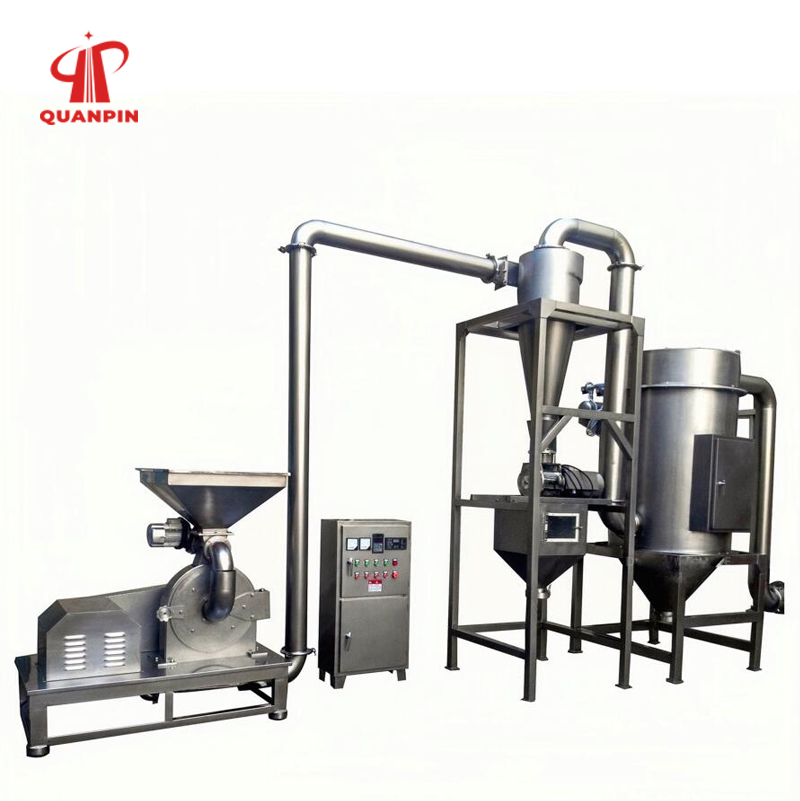
Equipment selection should use the material’s actual hazards and the proposed installation scope. A product photograph cannot establish every protective feature or connection.
A useful enquiry identifies the powder, intended processing duty, receiving route and questions to be tested. Include known handling restrictions and required documentation.
Ask QUANPIN to confirm the supplied configuration and division of responsibilities. Request evidence for any proposed feature rather than assuming it from a generic equipment term.
Prepare an Equipment Enquiry
Retain the trial record, specimen identities and analytical reports together. Later reviewers should be able to trace a reported charge value back to its actual handling history.
Record unresolved explanations explicitly. A clear account of what remains unknown is more useful than an unsupported claim that one mechanism has been established.
Retain Evidence with Its Limitations
Discuss your powder-processing enquiry with QUANPIN using the verified product and contact links below. Explain which observations the trial must establish and which equipment interfaces require confirmation.
A documented contact history helps a reviewer interpret the results without promising an untested outcome. Keep the equipment proposal, analytical evidence and safety responsibilities clearly connected.
Frequently Asked Questions
Does particle size establish electrostatic charge?
No. Particle size and electrical charge are separate properties measured by different methods. A size result does not independently establish the charge carried by a specimen.
Can a laboratory test predict production charging?
Not automatically. Published comparisons show that the arrangement can affect the magnitude or polarity measured. Representative testing and an explicit applicability review remain necessary.
Does charge always worsen powder flow?
No universal effect is established here. Interactions depend on materials, surfaces and conditions; observations from one experiment cannot establish the direction of change in every powder.
Does visible adhesion prove electrostatic charging?
No. Adhesion is an observation with potentially several causes. A supported interpretation requires appropriate investigation and evidence for the actual material and location.
Can grounding requirements be inferred from this article?
No. Electrical protection and safe handling must be determined through the appropriate assessment for the installation. This educational discussion does not specify electrical modifications.
What should accompany an enquiry?
Provide the actual formulation family, material condition, processing objective, transfer route and required tests. Identify responsibilities and known restrictions before agreeing the trial.
Discuss Your Powder-Processing Trial
Discuss your material and study requirements with QUANPIN using the enquiry form.
Email sales@qpdryer.com or stacie@qpdryer.com. Call +86 19850785582, or contact us on WhatsApp: +86 15921493205.