Ribbon Mixer for Seasoning Powders: Define the Meaning of a Recipe Percentage Before Charging
By QUANPIN
A seasoning recipe percentage is meaningful only when its calculation basis is clear. State whether an ingredient proportion refers to the complete intended charge or another explicitly defined formulation boundary before using it in a ribbon mixer enquiry.
A shared ingredient name does not resolve an ambiguous denominator, and the mixer cannot correct a recipe interpretation that was never agreed. Explore matching food applications.
What Does the Recipe Percentage Refer To?
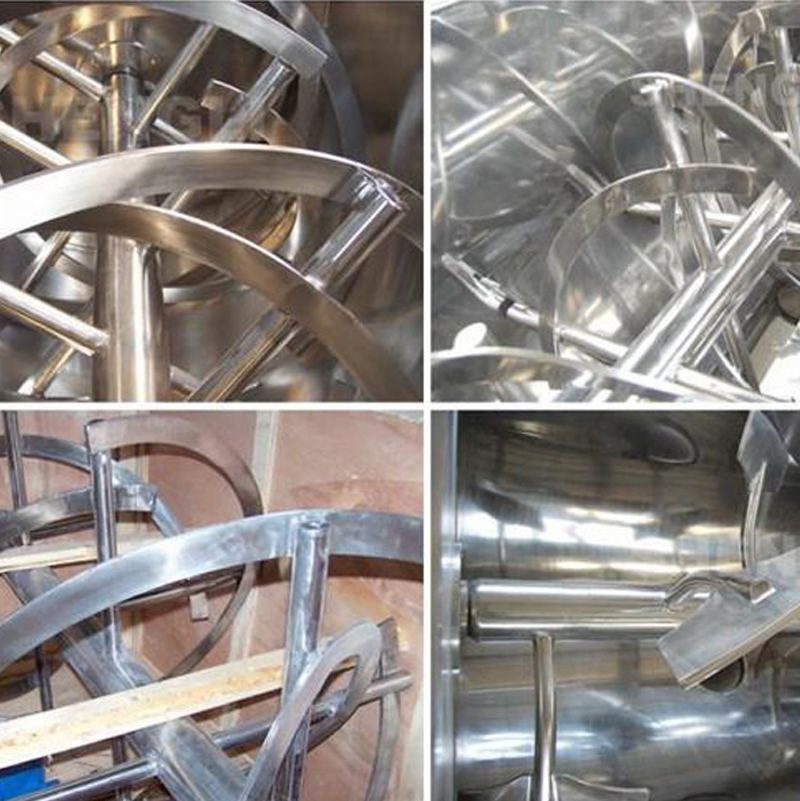
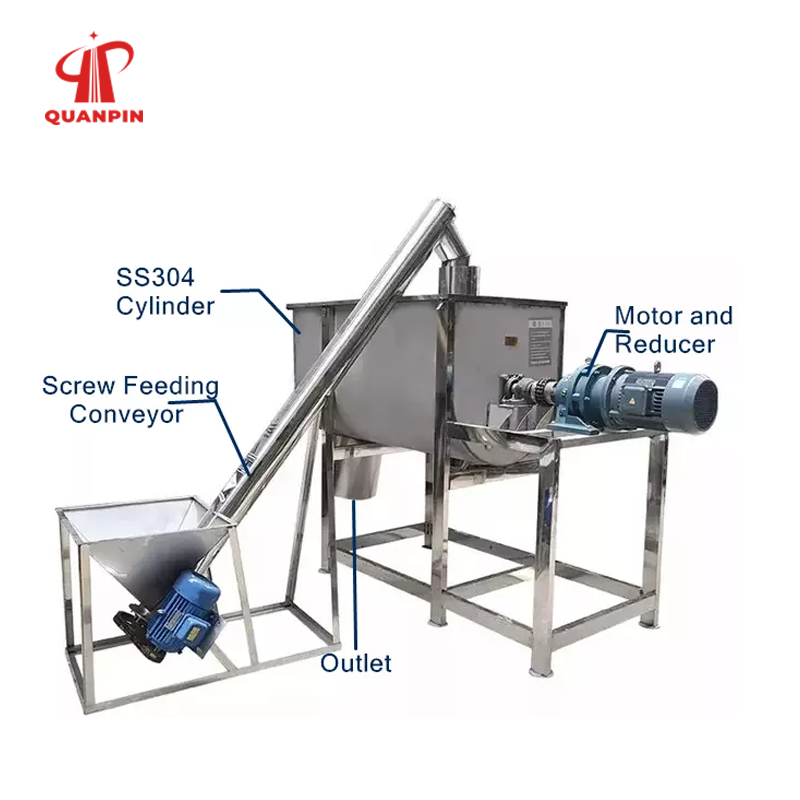
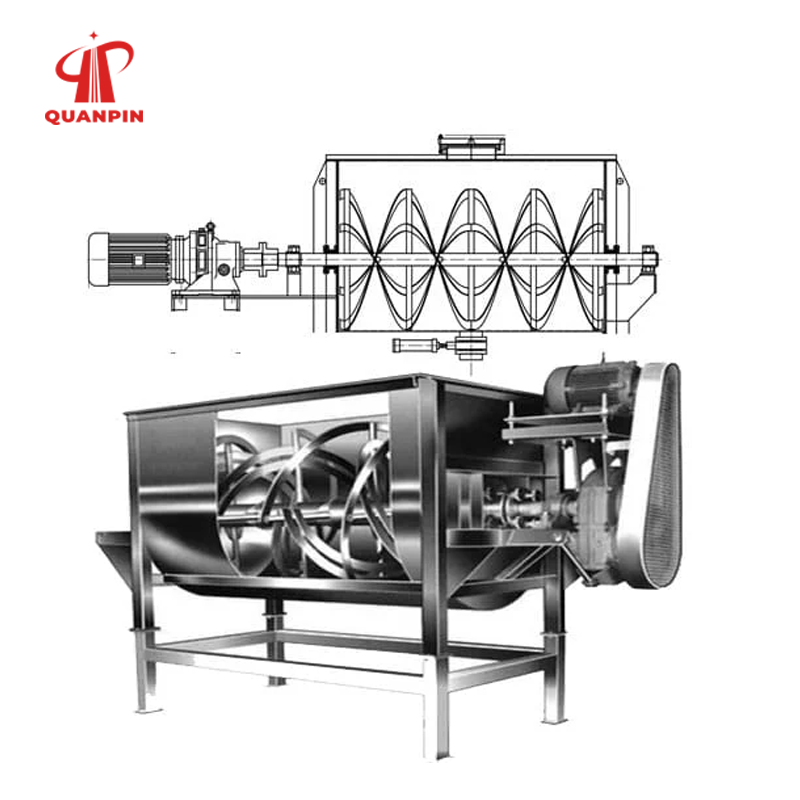
The WLDH ribbon blender circulates compatible material through a trough using inner and outer helical ribbons.
Its verified mixing principle does not independently determine ingredient amounts or confirm the customer’s formulation calculation.
Ribbon Mixing and Formulation Responsibilities
A horizontal ribbon mixer trial should identify the recipe version and the meaning of every reported ingredient proportion.
Keep the formulation basis separate from the amount actually transferred into the working batch.
Five Steps to Define the Ingredient Basis
Identify the recipe
Identify the intended food formulation and recipe version.
Define the denominator
State the denominator used for each reported proportion.
Describe supplied ingredients
Describe supplied ingredient forms and premixes.
Record actual charging
Record the actual material charged for the trial.
Assess the correct formulation
Compare product results against the correctly identified formulation.
Four Calculation and Material Distinctions
A proportion of the total charge differs from a proportion relative to one selected ingredient.
A supplied premix can contain several constituents, while the charging record may identify it as one incoming material.
A dry-component basis and an as-supplied material basis need an explicit relationship before comparison.
A quoted percentage without its denominator should remain unresolved rather than receive an assumed interpretation.

Charging, Mixing and Receiving Interfaces
Ingredient charging
The charging arrangement defines how the actual supplied ingredients enter the mixer.
Working trough
The trough holds the reviewed working batch and its product-contact scope.
Ribbon assembly
The ribbon assembly provides mechanical circulation within that configuration.
Optional dosing
Optional liquid or special dosing arrangements require explicit confirmation rather than inference from the equipment name.
Mixer discharge
Discharge defines the point where the processed mixture leaves the vessel.
External collection
External collection or packing introduces a separate product-handling boundary.
Interpreting the Actual Seasoning Formulation
Preserve ingredient form
A ribbon powder mixer development record should preserve the actual supplied form of each ingredient.
If a carrier is already present within a purchased premix, keep that relationship visible rather than silently adding or removing it from the calculation.
Do not infer proprietary premix composition when the supplier information does not establish it.
Keep recipe changes visible
If the formulation basis changes, identify the change before comparing a new trial with an older batch.
The intended recipe and actual charge should remain distinguishable when a transfer is incomplete or another documented event occurs.
An industrial ribbon blender quotation should describe the equipment duty derived from the confirmed formulation, not an ambiguous percentage list.
Resolve the formulation basis
A visually similar seasoning does not prove that two recipes use the same calculation basis.
Analytical acceptance should use the relevant product requirements and appropriate methods.
The formulation owner must resolve an unclear ingredient basis before an equipment trial is treated as representative of that recipe.
Food Application and Evidence Limits
A clear percentage definition helps prevent a calculation ambiguity from being mistaken for a mixing-performance issue. Food equipment and processing need appropriate hygiene controls. See FDA food manufacturing practices.
It also makes supplied premixes and separately added ingredients easier to describe consistently. Identify allergens and cross-contact requirements when ingredients or carriers introduce them. See FDA food allergen information.
The definition does not establish blend uniformity or a universal recipe for the product. Water activity describes a property different from total moisture content. See FDA water activity background.
Food safety and allergen considerations remain linked to the actual ingredients and process rather than the percentage format alone.
Document Recipe and Calculation Identity
Record the recipe reference and version.
Identify the denominator associated with the stated proportions.
Charge Records, Handling and Safety
Describe ingredients as actually supplied, including documented premix carriers.
Preserve the actual charging record and relevant deviations.
State the receiving and packing boundary used for product assessment.
Keep unresolved composition or calculation questions explicitly marked for the responsible formulation review.
Charging and inspection must follow the actual mixer’s operating and safe-access procedures. Include relevant sanitation and handling requirements in the food-process review. See FDA sanitation and transportation resources.
Food-contact hygiene and relevant sanitation controls apply to the complete ingredient and handling route.
Provide QUANPIN with the Confirmed Recipe Scope
Send QUANPIN the confirmed ingredient forms and an unambiguous formulation description.
Identify optional dosing functions that need supplier confirmation without assuming that the mixer verifies the recipe calculation. Food hazard analysis and relevant preventive controls are separate from demonstrating a preferred ingredient appearance. See FDA preventive controls for human food.
Retain the Formulation Basis and Its Limits
The equipment enquiry should distinguish formulation responsibility from the confirmed mixing and handling scope.
Retain the agreed recipe basis with the representative trial configuration and product results.
Frequently Asked Questions
Is a percentage alone a complete instruction?
A percentage without a defined denominator is not a complete formulation instruction.
Can a premix contain several constituents?
A premix may be charged as one material while containing several documented constituents.
Are dry and as-supplied bases equivalent?
As-supplied and dry-component proportions should not be treated as equivalent without a justified basis.
Does the mixer verify formulation calculations?
The mixer does not establish or correct an unresolved recipe calculation.
Does similar appearance prove equal composition?
A similar appearance does not demonstrate equivalent composition or blend acceptance.
What should the enquiry identify?
The enquiry should identify recipe version, ingredient forms, calculation basis and actual equipment duty.
Discuss Your Ribbon-Mixing Application with QUANPIN
Discuss the matching QUANPIN equipment with QUANPIN. Use the enquiry form or our contact page to describe the actual application.
Email sales@qpdryer.com or stacie@qpdryer.com. Call +86 19850785582, or contact us on WhatsApp: +86 15921493205.