A mesh-belt dryer carries a prepared layer of vegetable slices, strips or other suitable permeable material through a heated chamber. Forced air passes through the mesh and the product bed, supplying heat and carrying released moisture away. In the DW arrangement, separately circulated sections allow the process to be reviewed along the conveying path. The central production advantage is continuous material movement, provided that feed preparation and distribution keep pace with the drying operation.
A useful equipment specification connects feed preparation, the working mechanism and the condition required at discharge. The sequence below explains those connections for production teams comparing configurations. It focuses on the decisions that affect material movement and drying or granulation behavior, without assigning an unverified capacity, operating temperature or product quality claim to the machine.
- Prepare a feed that can travel on the belt. Define the vegetable, cut shape, size distribution and upstream washing or other preparation. The material must remain supported while allowing suitable airflow through the layer. A mixed feed containing large pieces and fine fragments can create different drying conditions within the same nominal production run. Review the Belt Dryer around these material and process requirements. The food process also needs a hazard analysis appropriate to the product; biological, chemical and physical hazards are addressed in 21 CFR 117.130.
- Remove avoidable surface water consistently. Drain the prepared vegetables before feeding so that the dryer receives a defined moisture load. Wet material that arrives in intermittent pools presents a different evaporation duty from a consistently drained feed. Record the preparation and drainage arrangement when discussing the required throughput with the equipment team. Review the belt conveyor drying around these material and process requirements.
- Distribute the material across the belt. The feeder should produce a repeatable layer rather than alternating piles and empty areas. Bed depth affects airflow resistance and the amount of material exposed to the moving air. Compare the actual loading pattern across the width, because average feed mass alone does not describe local drying conditions. Review the mesh-belt dryer around these material and process requirements.
- Understand the through-flow mechanism. Heated air moves through the permeable belt and vegetable bed, transferring energy to the material. Moisture leaves the exposed surfaces as vapor. Product permeability is therefore a process variable: flattened, overlapping or compacted material can change air passage even when the belt speed and heating setting remain unchanged. Review the through-flow drying around these material and process requirements. Preparation and drying must protect food from contamination and allergen cross-contact, as specified for covered operations in 21 CFR 117.80.
- Set residence time through conveying. The selected belt speed determines how long the material remains within the chamber. That time should suit the feed and required final condition. Increasing speed to accept a larger incoming flow also changes exposure time, so feed rate, layer depth and speed need to be considered together.
- Review each circulated section. The DW design uses separate air circulation in its drying sections. This supports review of conditions along the machine instead of assuming one air condition is suitable for the entire moisture removal path. The selected arrangement should respect product temperature limits and the changing state of the vegetables as drying progresses.
- Balance recirculation and exhaust. Reusing heated air retains useful heat, while exhausting a portion removes accumulated moisture. Both functions are necessary to the intended process. A problem with moisture removal cannot always be corrected by increasing heat input; investigate the air path and exhaust arrangement alongside product loading and feed preparation.
- Use continuity as a line advantage. A moving belt can connect preparation to ongoing discharge without repeated tray loading cycles. The practical benefit depends on upstream supply, collection and cleaning arrangements. Interruptions in preparation can still create an uneven duty, and a full receiving container can stop an otherwise continuous dryer.
- Sample across the output. Compare finished material from representative belt positions and operating periods. A sample from a single edge or a brief stable period may miss feed distribution problems. Define moisture and quality checks around the intended ingredient specification, including any relevant appearance or physical integrity requirements agreed for the product.
- Handle discharge as part of quality control. Dried vegetables may become brittle, and unnecessary drops can create fragments. Select collection and onward conveying around the product form required by the purchaser. Protect the material from unwanted moisture pickup after drying, since the belt chamber cannot control the environment of an open downstream holding area. Protective storage and transport conditions remain relevant after discharge, as described in 21 CFR 117.93.
- Plan cleaning and inspection access. Review the belt, supports, product-contact areas and places where fragments can accumulate. The vegetable preparation and intended manufacturing setting determine hygiene requirements. Cleaning time and access should be discussed before configuration selection so the proposed continuous workflow includes realistic production changeovers and inspection activities. Equipment cleaning and sanitation should protect the food and food-contact surfaces, as addressed in 21 CFR 117.35.
- Specify a complete evaporation duty. Provide QUANPIN with vegetable dimensions, initial and final moisture requirements, feed rate and thermal limits. Include the prepared feed condition, available utilities and downstream handling. Compare proposals against the same material definition and acceptance method rather than treating belt width or chamber length as an independent guarantee of finished-product output. Cleanable equipment construction and adequate maintenance are part of food equipment selection under 21 CFR 117.40.
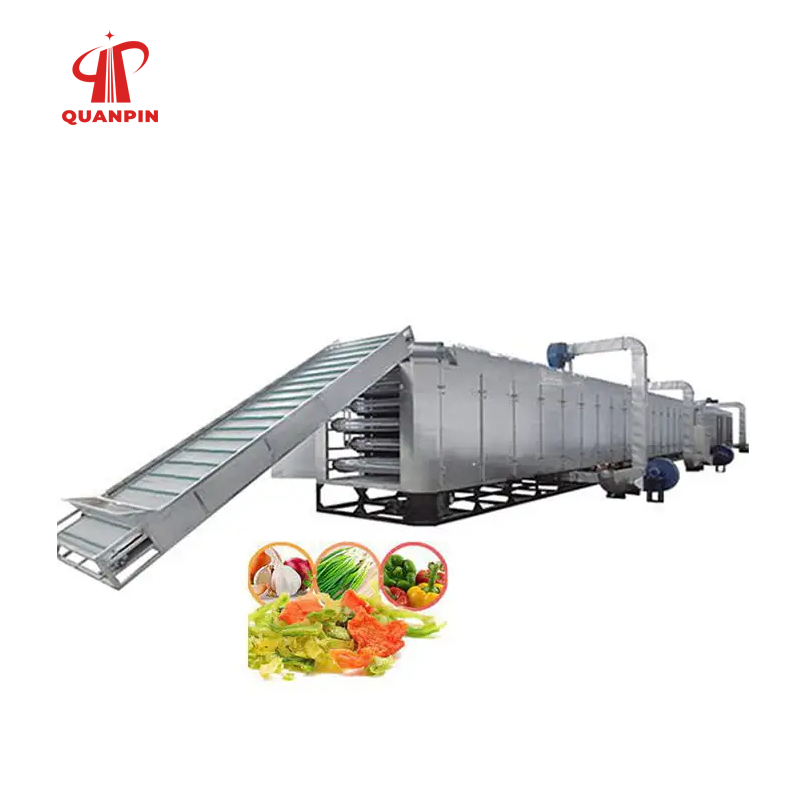
For process evaluation, consider the industrial food dryer for continuous hot-air drying on a moving belt. Confirm suitability with representative material, the required product properties and the proposed process conditions.
YANCHENG QUANPIN MACHINERY CO.. LTD
Sales Manager – Stacie Tang
MP: +86 19850785582
Tel: +86 0515-69038899
E-mail: stacie@qpdryer.com
WhatsAPP: 8615921493205
https://quanpindrying.en.alibaba.com/
Address: Jiangsu Province, China.