Food Ingredient Drying: Design Product-Specific Sorption Tests Before Setting Packing Conditions
By QUANPIN
A drying endpoint tells you how the food left the dryer. A moisture sorption curve helps investigate how that ingredient may exchange water with its surroundings afterwards. For a new ingredient, measure the relevant adsorption and desorption paths before using a borrowed curve to set packing conditions.
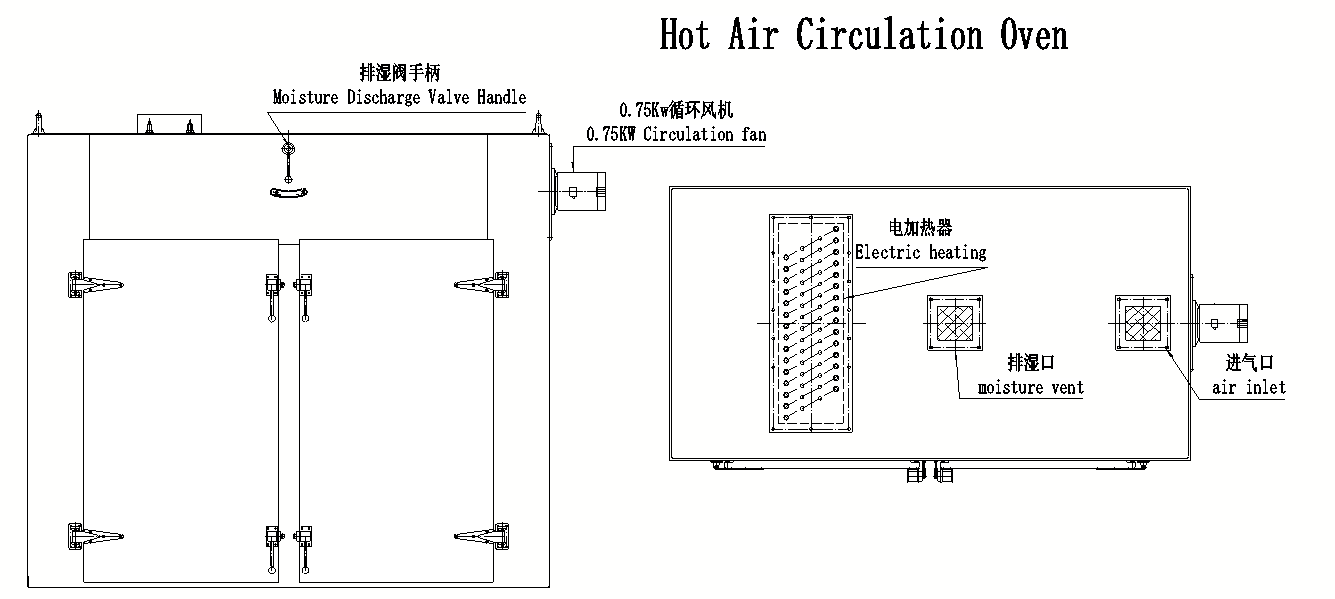
A hot air circulation oven can form part of a food development trial, but it does not supply the product-specific equilibrium data. Define the material, test temperature, moisture basis and intended storage conditions before comparing candidate drying schedules.
What a sorption test adds to a drying trial
A sorption isotherm relates equilibrium moisture content to water activity at a stated temperature. It is not the same graph as a drying curve, which follows moisture loss over time under particular operating conditions.
Adsorption starts with a relatively dry sample gaining water; desorption follows a wetter sample losing water. When their equilibrium paths differ, the difference is described as hysteresis. Preserve which route produced every observation.
Define the product before borrowing a curve
A packing decision needs a relevant product boundary. Whole fruit pieces, powders, extracted proteins and osmotically treated vegetables have different compositions and structures, even when the same moisture percentage is reported.
Begin with a defined question: how much water can this ingredient gain before its agreed quality changes? A hot air drying oven trial and a subsequent sorption study answer connected questions, but require different measurements.
Record five essential conditioning inputs
Food identity and treatment
Record the actual food lot, variety and pretreatment. Include added sugars, carriers or salt; changes in formulation can change the relationship between water content and water activity.
Moisture reporting basis
State whether moisture is expressed on a wet or dry basis. Keep original measurements and conversion calculations together so a change in reporting convention cannot masquerade as different material behaviour.
Conditioning temperature
Record the temperature at each equilibrium step, rather than simply the room setpoint. Comparing curves obtained at different temperatures requires an explicit explanation of that difference.
Adsorption or desorption history
Describe the initial condition and direction of conditioning. An adsorption result from a previously dried sample should not be silently substituted for desorption from fresh or partially dried material.
Relevant quality response
Choose a quality response appropriate to the ingredient: texture, flow, solubility or another agreed property. Water activity alone does not establish that every quality requirement has been met.
Connect equilibrium data with a quality response
In research on dried mango, apple and banana, moisture sorption models were considered together with glass-transition measurements. The moisture values associated with physical quality change were not simply identical to modelled monolayer moisture values.
That finding supports a practical distinction: a fitted moisture-binding parameter is not automatically an acceptance limit. Validate the quality response of the actual product at its intended temperature.
Avoid treating a good mathematical fit as proof of long-term shelf life. A fitted curve describes the observations and assumptions used to build it; actual package performance also depends on its exposure conditions.
For a tray dryer enquiry, describe the desired discharge condition separately from the proposed post-drying conditioning study. This keeps equipment duty and food stability evidence traceable.
Run a reproducible sorption study
Select specimens
Select representative portions from a traceable lot. Preserve differences in cut size or pretreatment as explicit factors rather than combining all portions into one unidentified sample.
Prepare both paths
Prepare adsorption and desorption specimens according to the agreed method. Prevent uncontrolled room exposure between preparation, weighing and sealing, and document any unavoidable delay.
Control humidity
Condition specimens at a series of controlled humidity environments. Use the test laboratory’s established procedure for temperature control and handling of the conditioning media.
Define equilibrium
Define an equilibrium criterion before testing. A single unchanged-looking reading is not an adequate substitute for a documented mass-stability decision and recorded observation interval.
Measure matched specimens
Measure water activity and moisture using appropriate methods on matched specimens. Repeatedly opening one container for unrelated tests can alter the very condition being investigated.
Fit and inspect models
Fit candidate models only within the measured range, examine residuals and retain original data. Report variation among replicate specimens alongside the smooth fitted line.
Interpret five original studies within their limits
Tropical-fruit desorption
A tropical-fruit desorption study experimentally measured banana, mango and pineapple under controlled conditions and compared BET and GAB descriptions. Model suitability depended on the activity range being described.
Use that result as a reason to identify the measured range in a supplier report. It does not provide universal coefficients for a different variety, pretreatment or drying process.
The engineering question is whether the proposed measurements cover the expected exposure. Additional decimal places in a fitted coefficient cannot compensate for missing observations near the intended use condition.

Different food matrices
A whitefish-skin gelatin powder study investigated adsorption, desorption and temperature effects in a protein ingredient. It illustrates a different food matrix; its curve should not be transferred to fruit or vegetable pieces.
A separate study of sweet potato treated in sugar beet molasses considered mass transfer and sorption modelling after osmotic treatment. Added solids make treatment history an essential part of the sample description.
Taken together, these studies support product-specific testing. They do not establish that a single formulation change will improve every food or that one dryer configuration guarantees the reported properties.
Cornelian cherry drying and sorption
For cornelian cherry fruits, investigators measured drying kinetics and sorption behaviour under controlled air conditions. Keeping those two experiments distinct helped connect moisture removal with equilibrium behaviour.
The resulting models belonged to that material and experimental domain. Use such studies to design the questions for a new trial, rather than copying their fitted settings into a purchase specification.
A useful report therefore contains both the drying history and the equilibrium-test history. Without the former, apparently comparable specimens may have reached the laboratory through different physical routes.
Review the curves without hiding uncertainty
Plot adsorption and desorption observations separately before considering a combined model. Where the paths diverge, show the difference rather than averaging it away.
Check that the moisture axis uses the same basis for every series. If temperature changes between experiments, label it directly in the plot and the accompanying table.
A second food lot is a useful challenge to a promising result. Agreement within one carefully selected lot should not be presented as demonstrated robustness across normal supply variation.
If the quality response changes without a clear moisture trend, review formulation, specimen geometry and the measurement method. Avoid forcing all unexplained behaviour into the sorption model.
Turn sorption data into a packaging question
Use the curve to define a meaningful packaging exposure study, including the initial product condition and the expected humidity and temperature range.
Confirm actual package performance through suitable testing. An equilibrium experiment does not directly reproduce the rate of water transmission through a real package or every distribution condition.
Prepare an equipment enquiry with usable evidence
For an equipment discussion, identify the ingredient and its preparation route. Include whether the material is a piece, flake, paste or powder and how it will be supported during drying.
Provide measured incoming moisture and the required final reporting basis. Distinguish an absolute specification from a provisional target that still requires product trials.
Describe the proposed tray load and airflow access. A laboratory sorption specimen is much smaller than a production load and does not demonstrate full-load drying uniformity.
Identify the product-temperature observations needed during the trial. Do not infer product temperature solely from the heater or circulating-air setpoint.
Define the unloading, cooling and packaging interface. Re-exposure before sealing may change the initial state used in the packaging study.
Ask which utility, controls and sampling provisions are included. Compare hot air tray dryer price only after the proposed scope and verification responsibilities are clear.
Choose the dryer for the actual duty
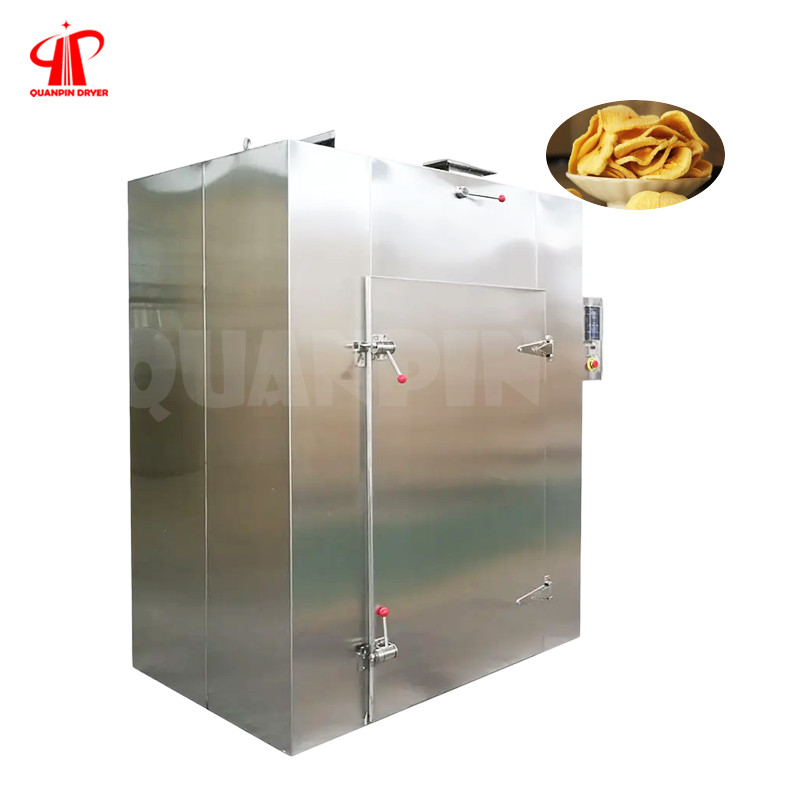
Select equipment according to the actual material and trial results. A tray dryer may be considered for suitable batch duties, while the final configuration still requires review of loading and product requirements.
No sorption paper establishes QUANPIN capacity, energy use or a validated shelf life. Those claims need separate project-specific evidence and agreed test boundaries.
Set a defensible development decision
Accept a development result when the test method, material identity, conditioning direction and measured quality response are all documented and reproducible.
If a proposed specification depends on an untested temperature or formulation, retain it as a question for further work. Do not hide that gap behind a high model-fit statistic.
Frequently Asked Questions
Is moisture content the same as water activity?
No. Moisture content measures how much water is present; water activity describes its thermodynamic availability under the measurement conditions. Neither should be substituted for the other without product-specific evidence.
Can adsorption replace desorption?
Not automatically. Adsorption and desorption follow different conditioning histories. Measure both when the intended process or storage question makes their possible difference relevant.
Is monolayer moisture an acceptance limit?
No. A monolayer estimate is a model parameter, not a universal texture, microbial or shelf-life limit. Link acceptance to the actual property and product under investigation.
Can another fruit supply the curve?
Not reliably. Variety, formulation, pretreatment and physical structure can alter the response. A related food provides a research starting point, not a replacement dataset.
Does a dryer measure the isotherm?
No. The dryer supplies the moisture-removal operation; controlled equilibrium testing is a separate experimental activity. Agree who provides that testing and how samples are preserved.
What should the first study establish?
Start with traceable material, a defined temperature and humidity domain, an explicit equilibrium criterion and a relevant quality response. Then use the findings to refine the drying and packing trial.
Discuss Your Food Drying Trial
Discuss the material, processing objective and required trials with QUANPIN. Review the equipment information and the relevant industry applications, or send an enquiry through our contact page.
Email sales@qpdryer.com or stacie@qpdryer.com. Call +86 19850785582 or contact WhatsApp +86 15921493205 to discuss the proposed scope.
For process evaluation, consider the hot air oven for batch tray drying with circulating hot air. Confirm suitability with representative material, the required product properties and the proposed process conditions.