DSH Powder Mixing Trials: Choose the Tracer and Counting Baseline Before Judging Variation
By QUANPIN
Counting a few visible tracer particles is not the same measurement as assaying a dissolved ingredient. Even a randomly dispersed population produces fluctuating counts between small samples. A useful powder-blending trial defines the tracer, detection method and counting scale before interpreting the coefficient of variation.
For a conical screw mixer enquiry, ask what the tracer actually represents. A convenient marker may be easy to detect while moving differently from the ingredient of interest. Statistical precision cannot repair a physically unrepresentative tracer or make an unsuitable sampling route representative.
What a tracer count can and cannot establish
A counting baseline explains variation expected from the measurement design. Under a Poisson model, variance equals the mean and the coefficient of variation decreases as the expected count increases. These relationships are model properties, not a mixer performance guarantee or a universal acceptance rule.
The assumptions matter. Counts affected by clumps, correlated particles, variable specimen mass or changing detection efficiency may not follow that baseline. Investigate those mechanisms instead of subtracting an assumed random variance automatically from every observed result.
Define the question before collecting results
A trial should distinguish particle detection, ingredient concentration and mixing dynamics. Each answers a different question. Decide which output supports the purchasing or development decision, and keep the original measurements available when translating them into a mixing index.
The framework below proposes an interpretable trial design. It does not prescribe a tracer for food or pharmaceutical manufacture, establish permission to introduce a marker, or qualify a particular QUANPIN configuration for a regulated application.
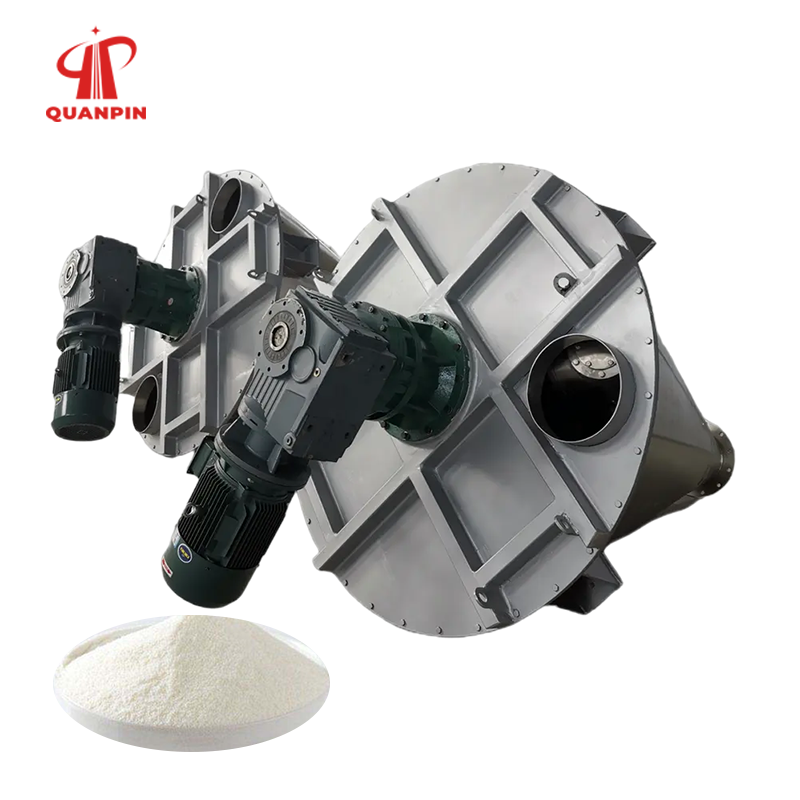
Five decisions that determine an interpretable count
Target ingredient
Describe the target ingredient and its relevant size, density and handling characteristics. A coloured material chosen solely for contrast may be unsuitable if those differences cause its distribution to diverge from the target component.
Counted object
Define what constitutes one counted object. Distinguish individual particles, attached clusters and image features; a change in segmentation can change the reported count without changing the actual distribution in the vessel.
Specimen scale
Set the specimen mass or observed area before collecting data. Document any departures so that results from different sampling scales are not pooled into a single unexplained coefficient of variation.
Detection route
Check the detection route using known preparations where appropriate. Retain information on background interference, missed particles and overlapping features rather than reporting software precision as if it described the full analytical method.
Trial material control
Agree how the trial material will be identified, contained and disposed of. Suitability for research detection is not authorization to add that substance to commercial product or to return trial material to production.
Use statistical baselines without claiming process proof
NIST describes the Poisson distribution with a mean and variance controlled by its parameter and a coefficient of variation of one divided by its square root. This provides a transparent starting point for discussing count variability under the model assumptions.
For illustration, increasing the expected particles per specimen reduces relative counting fluctuation in that model. This is a mathematical explanation, not an experimentally established threshold for acceptable composition uniformity in the proposed mixer trial.
Cremer laboratory teaching material on counting statistics explains how fluctuating mean rates can produce greater variation than a simple fixed-rate Poisson description. The general statistical lesson is useful when considering why a single baseline may not describe every measurement series.
Its biological examples are not powder-blender validation experiments. Applying that lesson to a blend trial requires separate evidence about particle independence, specimen scale and detection behaviour; the analogy does not establish a physical cause for an observed failure.

Build the tracer comparison in six steps
Define the objective
Specify the trial question before selecting the marker. Decide whether the test concerns distribution across locations, progression over time or behaviour during discharge. Avoid asking one measurement series to prove every property of the blend.
Select candidate markers
Choose candidate tracers with the target material and analytical method in mind. Compare relevant handling characteristics and identify any differences that could influence transport, adhesion, segregation or visibility during the proposed trial.
Plan collection
Define a collection plan with known sample identities. Keep location and time information attached to each specimen rather than losing it when results are averaged across a batch or converted into a single index.
Establish the measurement
Establish the count or assay procedure before interpreting process results. Record preparation, detection settings and repeat analysis so that a discrepancy in the analytical route can be distinguished from a real distribution difference.
Inspect raw results
Examine raw results alongside the chosen statistical summary. Look for changing means, unusual clusters or a relationship with specimen mass before assuming the observations form one comparable population.
Repeat comparably
Compare repeated trials under the same declared conditions. If the tracer or detection method changes, document a new comparison and explain why earlier numerical criteria remain appropriate, rather than carrying them forward without evidence.
Read three original mixing investigations in context
Tracer selection for continuous blending
A Rutgers research record describes work specifically concerned with selecting tracers for residence-time-distribution measurements in continuous powder blending. Its stated aim includes comparing profiles obtained using pulse methods and assessing the suitability of candidate tracers.
That original continuous-blending tracer study supports treating tracer selection as part of method development. Its residence-time question differs from a batch conical blender’s spatial composition question, so the resulting methodology cannot be transferred without examining that difference.
For a batch study, identify which aspects are genuinely relevant: marker behaviour, recovery and analytical detection may be useful considerations, while a continuous-system residence-time curve is not automatically the required batch acceptance output.
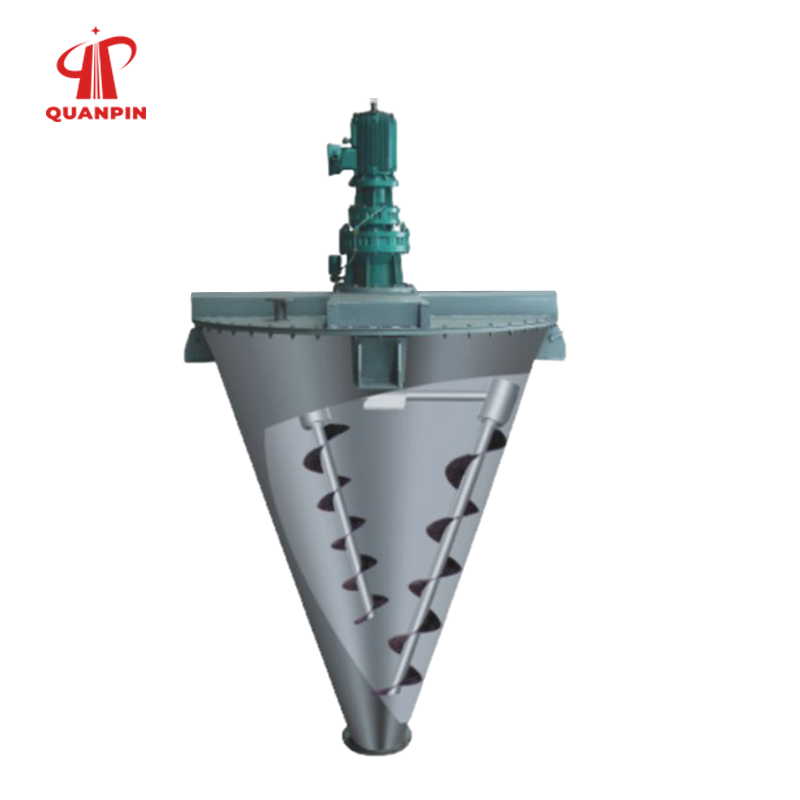
Coloured tracers in pharmaceutical development
A Monash university record describes a coloured-tracer method developed to evaluate progression of pharmaceutical dry-powder mixing and scale-up. The marker is intentionally mixing-sensitive, making its behaviour an essential part of what the method reports.
The coloured-tracer scale-up investigation illustrates a purpose-designed measurement approach. It does not show that every visible tracer follows an active ingredient, nor that a concentration result can be inferred from colour without appropriate method development.
When considering such research for equipment selection, distinguish an exploratory development tool from the method needed for actual product acceptance. An informative visual trial can still require independent composition measurements for the intended application.
Image analysis in a discontinuous mixer
A Karlsruhe accepted manuscript reports image-based determination of mixing time in a discontinuous mixer using a similarly behaving, optically identifiable tracer. It discusses statistical treatment and limitations of the measurement approach.
The original Karlsruhe mixing study used a particular experimental apparatus and model solid system. Its tracer evaluation includes physical compatibility and detection considerations; those are useful design questions, not proof of equivalent performance in a DSH mixer.
Do not reproduce the paper’s model materials or operating settings as a commercial food or pharmaceutical trial recipe. Use the research to improve the questions asked about representativeness and measurement limits in the actual proposed system.
Connect count interpretation to batch acceptance
For a double screw cone mixer comparison, state what a passing result means before testing. Separate an acceptable analytical method from acceptable process behaviour and from the commercial equipment scope being discussed.
If count variation is high, examine whether the mean count is low or the specimen mass varies. Consider detection repeatability and physical grouping as possible contributors; do not conclude that longer mixing must solve the observed difference.
If counts look consistent, verify that the tracer still represents the target ingredient. Uniform distribution of a marker can coexist with a different distribution of another component when their material behaviour differs.
Keep the analysis transparent enough for another reviewer to reproduce it. Provide sample identifiers, raw counts, specimen masses, exclusions and calculation definitions together with any summary mixing index.
Investigate apparent trends before adjusting mixing
A changing detection threshold can create an apparent improvement or deterioration. Preserve image-analysis settings and retain original images where feasible so that a reviewer can distinguish changes in classification from changes in the blend.
A trend with collection order may reflect discharge behaviour, sampling practice or the process itself. Investigate those alternatives with a planned comparison rather than erasing the trend by averaging the entire series.
Prepare the trial and equipment enquiry together
An enquiry for a double screw conical mixer should identify the actual powder system and the intended study objective. Describe ingredients, charging sequence and relevant handling observations without substituting a generic tracer experiment for the real material duty.
State whether the test is exploratory, a proposed acceptance comparison or part of a regulated qualification programme. The level of evidence and responsibility for approval depend on that purpose and should be agreed before collecting samples.
Provide the proposed collection route and explain where specimens can be obtained. Sampling accessibility and safe operation must be considered in the actual supplied configuration, not inferred from a photograph of another installation.
Describe the marker and analytical method separately from the machine specification. If a candidate has not been approved for the intended application, keep that limitation visible in the trial plan and subsequent report.
Ask who will perform laboratory analysis and who will interpret the statistical results. Equipment inspection, analytical method verification and product acceptance are separate responsibilities even when coordinated within the same development project.
Include the full proposed handover after mixing. A useful comparison follows the material through the operation being evaluated, while clearly limiting conclusions to the locations and times actually observed.
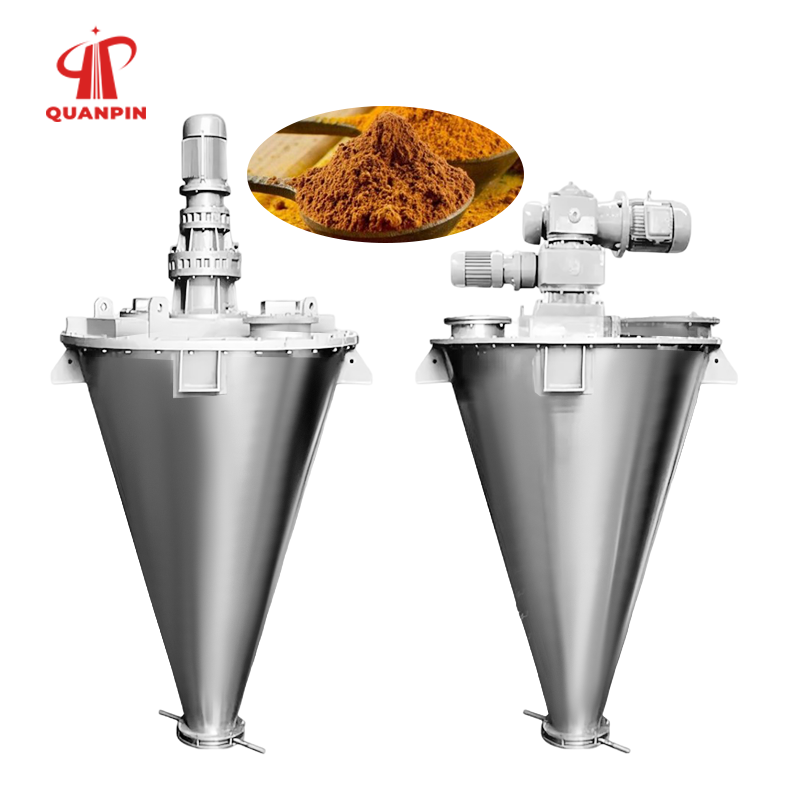
Confirm the actual supplied DSH configuration
A conical screw blender can be discussed within the genuine QUANPIN DSH product range. Selection still requires confirmation of the powder duty, loading, discharge, cleaning and sampling needs for the specific supplied configuration.
The conical powder mixer literature and counting examples here do not establish a capacity, mixing time, construction material or precision guarantee. Those details must come from the actual equipment proposal and relevant trial evidence.
Decide whether the evidence answers the question
Accept a comparison when the marker’s role, measurement scale and statistical interpretation are defensible for the intended question. Preserve unresolved limitations when available evidence cannot distinguish detection variation from process variation.
A reasonable development outcome may be to change the method rather than the mixer. Better tracer selection or a more appropriate collection scale can make a comparison interpretable without implying that equipment performance has changed.
Frequently Asked Questions
Does variation always mean poor mixing?
No. Small specimens can show count variation even under an idealized random distribution. Determine whether the model and measurement conditions are appropriate before assigning all variation to incomplete mixing.
Should we always use larger specimens?
Not necessarily. Changing sample mass also changes the scale of scrutiny. A lower relative counting fluctuation does not automatically provide better evidence for the specific composition-uniformity requirement.
Can one tracer represent every ingredient?
Only after appropriate justification. Relevant size, density, adhesion and detection differences must be considered. Ease of detection alone does not establish that the marker represents the ingredient of interest.
Can continuous methods validate batch mixers?
No. Continuous residence-time measurements and batch spatial measurements answer different questions. Research may suggest useful method-development considerations without supplying a ready-made acceptance procedure.
What data should be retained?
Retain sample identities, raw counts or signals, specimen masses, analytical settings and calculation definitions. Document exclusions and deviations so that a reviewer can understand how the reported result was obtained.
What should an enquiry contain?
Provide the actual material duty, intended trial question, proposed tracer and approved analytical route. Confirm sampling access and the supplied DSH configuration before relying on a development study for a purchasing decision.
Discuss Your Powder Mixing Trial
Discuss the material, processing objective and required trials with QUANPIN. Review the equipment information and the relevant industry applications, or send an enquiry through our contact page.
Email sales@qpdryer.com or stacie@qpdryer.com. Call +86 19850785582 or contact WhatsApp +86 15921493205 to discuss the proposed scope.