A starch-and-protein premix can contain ingredients with different flow behaviour, particle characteristics and handling sensitivities. Three-dimensional vessel motion repeatedly redirects the powder bed rather than driving a ribbon through it. This gives producers another blending route to assess when compatible dry ingredients can redistribute through movement of the vessel.
Choosing that route requires a definition of the finished blend and a realistic view of the surrounding process. The discussion below connects the motion principle with feed preparation, usable volume, practical advantages and collection. Application examples describe duties to evaluate; they do not establish suitability for every protein powder or starch formulation.
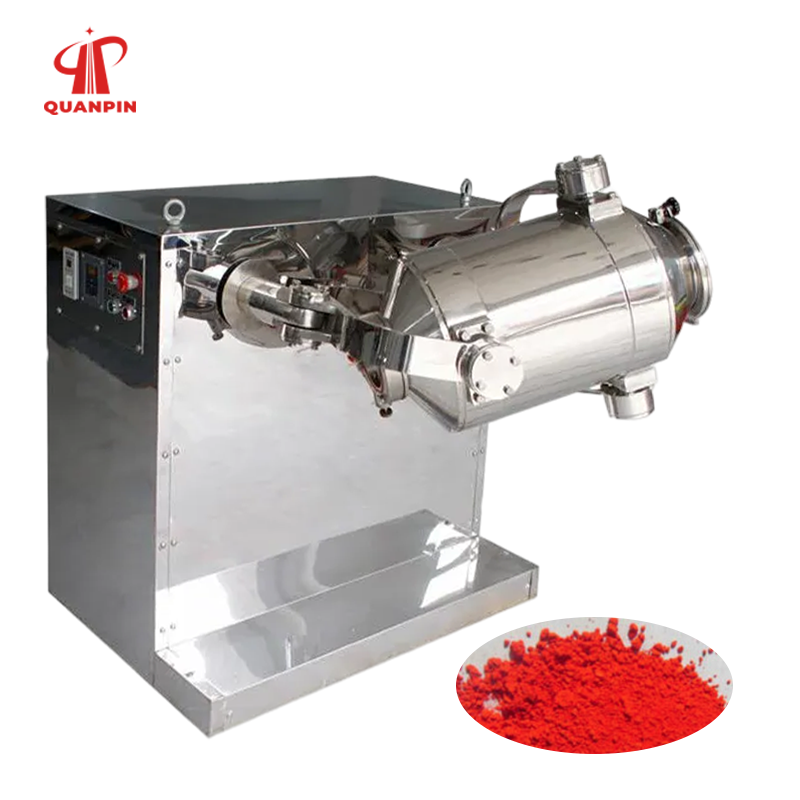
- A 3D powder mixer changes the orientation of its vessel through compound motion. The powder bed consequently changes direction and different portions encounter one another. This describes why the mechanism can redistribute compatible solids. It does not mean that vessel movement forces every particle into an identical trajectory or eliminates the influence of density, size and cohesion.
- Before specifying a three dimensional mixer, identify whether the feed can actually move as individual particles or small mobile portions. Protein powder that has compacted in storage may behave differently from freshly prepared material. Define any screening or deagglomeration stage before the blender. Separating preparation from blending makes the intended duty clearer and avoids expecting compound motion to perform every upstream operation.
- Relate the batch requested for a three dimensional powder mixer to its occupied volume. A carrier substitution may alter volume even if the weighed mass remains unchanged. Discuss density information, loading condition and the supplier-approved working fill for the selected configuration. The available room for material movement belongs in the process specification alongside the production quantity.
- A multidirectional mixer offers a vessel-motion approach without an internal ribbon as the blending element. That distinction can help when evaluating handling concepts for a compatible dry premix. It does not by itself establish superior speed or gentleness. If the recipe includes fragile granules, compare their condition before and after the proposed cycle under representative operating conditions.
- Make charging instructions specific enough to repeat. Identify the major carrier, any concentrated addition and whether a separate premix is needed for a small ingredient. Record container identification and the addition sequence. Correct weighing remains fundamental: changes in orientation can redistribute the material present, but cannot correct a component omitted from the recipe.
- Plan the machine within its complete movement envelope. Charging access, surrounding equipment and the discharge receiver must remain compatible with the moving assembly. Review the offered installation information rather than sizing the area from a static image. Include space for the agreed inspection and cleaning tasks so routine work can be performed under the intended access arrangements.
- Connect ingredient preparation with the blend stage. The FAO ingredient-preparation discussion discusses preparation, weighing and mixing within feed manufacture. Its general lesson is useful for a starch-and-protein process: a repeatable ingredient set is a prerequisite for interpreting blending results. The source does not validate a particular SYH cycle or establish that a food formulation will remain mixed through later transfers.
- Include the actual powders in the site hazard assessment. The CCOHS combustible-dust guidance explains how finely divided combustible materials can become explosible under suitable conditions and includes food powders in its discussion. This calls for a material-specific review of the installation. Neither a closed vessel nor its compound motion establishes the protective arrangements required for charging and emptying.
- Review powder escape and accumulation around transfer points. The HSE food dust-explosion guidance discusses dust explosion conditions and precautions in food processing. For a premix line, the practical question extends to the receiver, nearby surfaces and the intended collection method. Ask the responsible site personnel to assess these conditions with the formulation and the proposed installation information available.
- Check ingredient-specific exposure concerns before the charging method is fixed. The HSE bakery asthma guidance identifies flour dust and enzyme-containing bakery additives as causes of occupational asthma. Where these materials occur in the premix, consider bag opening and weighing as well as loading. Their presence affects the handling review independently of the blending principle selected.
- Use the HSE flour-handling leaflet as background for avoiding dust generation during flour handling and mixing. If the starch-and-protein application contains flour, discuss how material enters and leaves the vessel without unnecessary airborne release. The leaflet informs handling choices; it does not certify the mixer or demonstrate exposure control for the actual workplace arrangement.
- Define acceptance at the point where the next operation receives the premix. Review separation during pouring, the number of transfers and any intermediate storage conditions. Give QUANPIN representative material information, desired batch duty and the downstream layout, then request an application review. Include the entire operating cycle in the proposal so the selected blending route can be assessed as a production process.
Discuss your material and production route with QUANPIN. Review the corresponding equipment information before arranging a material trial.
YANCHENG QUANPIN MACHINERY CO.. LTD
Sales Manager – Stacie Tang
MP: +86 19850785582
Tel: +86 0515-69038899
E-mail: stacie@qpdryer.com
WhatsAPP: 8615921493205
https://quanpindrying.en.alibaba.com/
Address: Jiangsu Province, China.