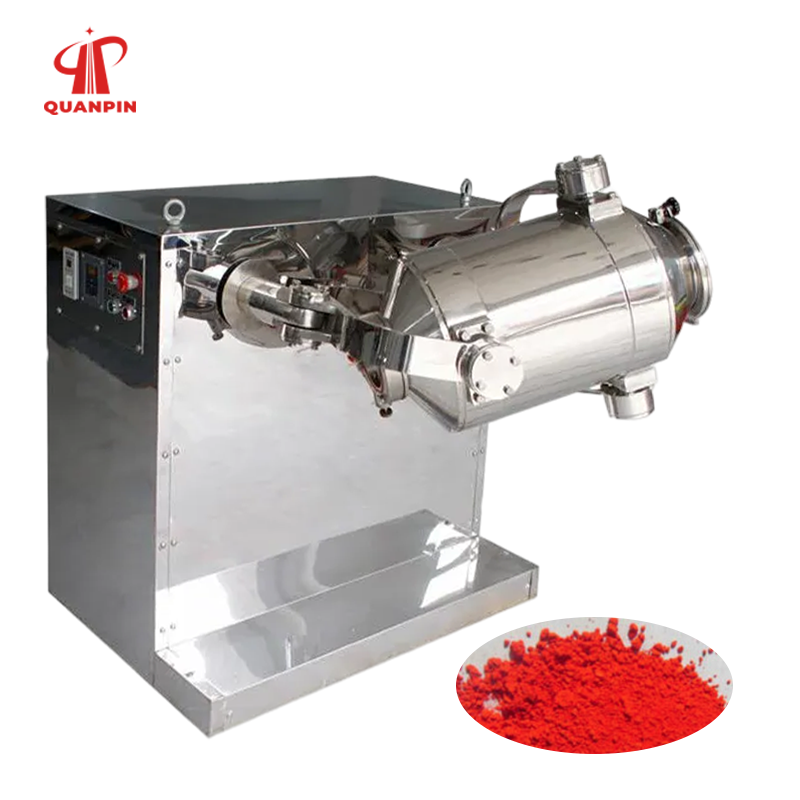
A 3D powder mixer changes the orientation of a closed vessel along several axes. The resulting material paths continually change, bringing different portions of the powder batch together. This can suit compatible dry solids that are able to move inside the container, provided loading, free space and discharge are planned with the mixing duty.
Mixing serves the finished formulation. Weighing, ingredient preparation, vessel movement and downstream transfer should form one connected batch route. Define what the next operation needs from the blend and keep recipe identity intact through every receiving and storage step.
- A three dimensional mixer works through compound vessel motion. Unlike a stationary trough with an internal ribbon, the vessel itself redirects the solids. As the orientation changes, material moves along different paths and portions of the batch repeatedly meet. The mechanism is redistribution through motion, rather than a claim that every particle follows an identical trajectory.
- A three dimensional powder mixer needs a material that can respond to those changing directions. Dry powders and granules are the stated starting point on the SYH page. Cohesive masses may move as lumps rather than separate particles. If deagglomeration is necessary, discuss a separate preparation operation instead of assuming vessel movement will perform intensive size reduction.
- A multidirectional mixer must have adequate clearance for its moving assembly. Floor layout, loading access and receiver position belong in the early equipment discussion. A machine that fits within its static footprint may still need additional space while operating or being cleaned. Use the approved installation information for the actual configuration before fixing adjacent equipment positions.
- Food applications can include compatible starch or protein powder formulations and other dry ingredient mixtures reviewed for this motion. Differences in particle density and size still influence the blend. Three-dimensional movement does not remove the physical tendency of some mixtures to separate later, particularly when the powder is poured, vibrated or transported through several receivers.
- The potential advantage is repeated redirection without an internal ribbon or screw agitator. That can offer a useful route for a suitable dry formulation. It should not be described as universally gentle, universally faster or capable of every loading level. Ingredient behaviour and the complete batch cycle determine whether the arrangement fits the intended product.
- Prepare ingredients before loading the vessel. Verify identity, weigh each addition and decide whether a minor component requires a premix. Introduce the ingredients through a defined sequence that can be repeated by operators. When the recipe changes, review the physical properties of the replacement ingredient rather than carrying over the previous operating instructions without checking them.
- FAO links ingredient preparation, accurate weighing and mixing in its feed-manufacturing discussion. For a three-dimensional food blending route, the transferable principle is to prepare and measure the components before loading. The source does not establish a SYH operating time or prove that every recipe will resist segregation after discharge. Read the FAO discussion of ingredient preparation and mixing for the supporting context.
- CCOHS explains that finely divided combustible materials can become explosible under suitable conditions and identifies food powders among relevant materials. Include the actual starch or protein recipe in the site assessment. A closed mixing vessel is one part of the installation and does not establish the protection level of its loading and discharge points. Read the CCOHS combustible dust guidance for the supporting context.
- HSE explains dust explosion conditions and precautions in food processing. For a rotating-vessel line, review powder escape during charging and emptying as well as accumulation around nearby equipment. The intended housekeeping method and collection arrangement should suit the material and site rather than depend on a generic equipment description. Read the HSE food dust explosion guidance for the supporting context.
- HSE identifies flour dust and enzyme-containing additives as causes of occupational asthma in bakery work. If these ingredients enter a three-dimensional mixing recipe, review exposure during weighing and charging. This ingredient-specific concern should be communicated alongside the blending duty rather than being inferred from the name of the mixer. Read the HSE bakery asthma guidance for the supporting context.
- HSE advises avoiding dust generation when loading and mixing flour. For a flour-containing batch in a compound-motion vessel, plan an appropriate charging and receiving arrangement. The leaflet provides handling context; it does not establish that this mixer eliminates exposure or that its vessel motion controls airborne powder outside the machine. Read the HSE flour handling leaflet for the supporting context.
- Specify a practical production cycle. Include loading, processing, discharge, inspection and changeover when discussing the required output. Give QUANPIN the complete formulation, feed condition, bulk density, target batch or hourly duty and downstream equipment arrangement. Request a configuration review with representative material before committing to the final scope. Acceptance should describe the usable product and operating conditions, rather than an unsupported promise of perfect powder or uniformity.
YANCHENG QUANPIN MACHINERY CO.. LTD
Sales Manager – Stacie Tang
MP: +86 19850785582
Tel: +86 0515-69038899
E-mail: stacie@qpdryer.com
WhatsAPP: 8615921493205
https://quanpindrying.en.alibaba.com/
Address: Jiangsu Province, China.