An air classifier mill combines particle breakage with a separation stage that decides which particles can leave the system. For a dry food powder, the practical purpose is to produce a useful ingredient fraction while keeping unsuitable coarse material in the grinding circuit. Fineness, feeding and collection therefore belong to one process discussion.
Grinding serves the next process. Feed preparation, controlled particle reduction and receiving equipment should form one connected material route. Define whether the powder will be blended, screened or packed, and explain what condition that operation needs from milling.
- Grinding begins with a prepared feed. Dry, sufficiently brittle pieces enter the pulverizing chamber, where high-speed mechanical action reduces their size. Material that deforms, smears or sticks behaves differently from brittle particles; it may coat internal surfaces rather than fracture cleanly. Moisture and ingredient composition help determine whether this route is suitable.
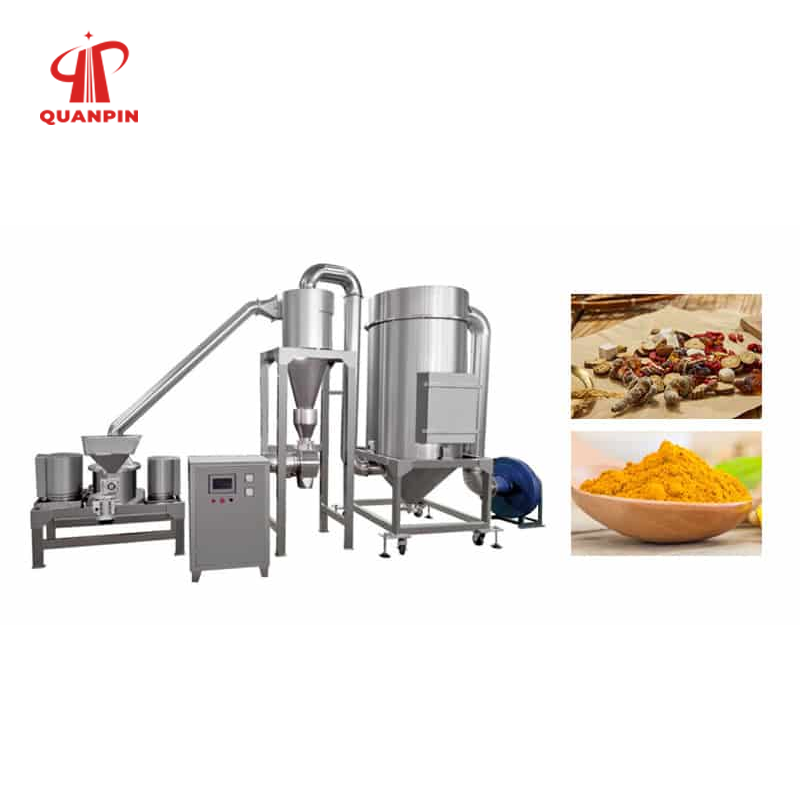
- Classification separates the finer fraction from particles that require more grinding. The WFJ product description states that oversize material returns for further size reduction, while accepted powder passes to collection. This internal return distinguishes the process from simply crushing everything once and hoping the discharge meets the intended food ingredient specification.
- An air classifying mill needs stable feeding because the grinder and classifier share the same material stream. Large surges change the solids loading presented to both operations. Prepare consistent inlet pieces, use the agreed feeding arrangement, and provide a buffer between upstream preparation and milling when the preceding operation releases material intermittently.
- The ACM mill should be selected around the finished ingredient rather than a mesh number alone. A starch ingredient for a dry premix and a protein powder for a beverage base may require different handling characteristics. Identify whether the main purpose is breaking coarse particles, improving blend compatibility or meeting a downstream screening requirement.
- A fine powder grinder is only one part of the collection route. Accepted product must be separated from conveying air and transferred into a suitable receiver. Ask which fractions are collected at each stage and how retained material is removed during changeover. A fine powder specification has little value if product handling immediately creates contamination or uncontrolled loss.
- The main process advantage is a connected grinding-and-classification circuit. Coarse particles can receive further treatment without requiring the entire collected batch to be returned manually. This does not guarantee a narrow distribution or a particular capacity for every material. Actual performance depends on brittleness, moisture, feed consistency and the agreed system arrangement.
- Particle reduction, screening and mixing are related operations. FAO describes impact, attrition and cutting as distinct ways of reducing ingredients. This provides general process context for preparing a compatible feed; it does not establish the classification curve, output or temperature rise of a WFJ installation. Read the FAO feed milling chapter for the supporting context.
- CCOHS explains the purpose and contents of safety data sheets for hazardous products. Include available ingredient hazard information in the milling specification and communicate relevant handling precautions to operators. Do not describe the feed only as a generic food powder. An SDS is one input to the assessment, and material-specific information may still be needed. Read the CCOHS safety data sheet guidance for supporting context.
- HSE provides separate control guidance for bag opening, weighing, conveying and dust collection in flour work. Where the food recipe contains flour, assess the handling stages around the mill as well as the mill itself. A contained grinding chamber does not address every charging and emptying task. Read the HSE guidance for flour handling for the supporting context.
- Rotating machine parts and points of operation require appropriate guarding. Review access to the feeder, transmission and grinding assembly when defining the installation. A product receiver should allow routine emptying without requiring operators to reach into dangerous moving equipment. Read the CCOHS safeguarding guidance for the supporting context.
- The published 2025 edition of 21 CFR Part 117 addresses cleanable equipment and protection from contamination. For a food milling project, identify the product-contact surfaces, collection receivers and dismantling needs. Treat this as design context, not as a claim that the proposed machine is certified for a particular market. Read the US food manufacturing equipment provisions for the supporting context.
- Specify a practical production cycle. Include loading, processing, discharge, inspection and changeover when discussing the required output. Give QUANPIN the complete formulation, feed condition, bulk density, target batch or hourly duty and downstream equipment arrangement. Request a configuration review with representative material before committing to the final scope. Acceptance should describe the usable product and operating conditions, rather than an unsupported promise of perfect powder or uniformity.
YANCHENG QUANPIN MACHINERY CO.. LTD
Sales Manager – Stacie Tang
MP: +86 19850785582
Tel: +86 0515-69038899
E-mail: stacie@qpdryer.com
WhatsAPP: 8615921493205
https://quanpindrying.en.alibaba.com/
Address: Jiangsu Province, China.