Food Powder Mixing: Track Moisture Equilibration after the Blend Leaves the Mixer
By QUANPIN
A food powder blend can meet its formulation ratio without immediately reaching moisture equilibrium. When ingredients begin in different moisture states, the evidence needed after mixing includes the conditions and timing of water-activity measurement, rather than only the total water carried into the batch.
For a conical screw mixer enquiry, identify the actual ingredients and their intended handling after discharge. Discuss distribution testing and moisture equilibration as related but distinct questions. A machine proposal should not imply that completing a blending cycle establishes the final water activity or storage life.
A mixing endpoint is not an equilibrium endpoint
Moisture content describes the amount of water in a material on a stated basis. Water activity describes a different thermodynamic property associated with water availability. The same moisture percentage can therefore have a different meaning when the ingredient composition or physical state changes.
Record the reporting basis whenever moisture results are compared. A value on a dry basis and one on a wet basis should not be placed beside each other as though they were directly interchangeable. Keep the analytical method and sample identity attached to the reported value.
Define the post-mixing question
The development question is whether a blend remains suitable through its real post-mixing sequence. Immediate discharge, temporary holding and final packaging are separate observation points. Their temperatures, containers and exposure histories can differ, so their measurements require clear stage labels.
This article proposes a trial framework for dry food ingredients. It gives no universal conditioning time, acceptable water activity, shelf-life claim or microbial lethality claim. Food-safety decisions and final-product limits belong to the product-specific assessment conducted by responsible qualified personnel.
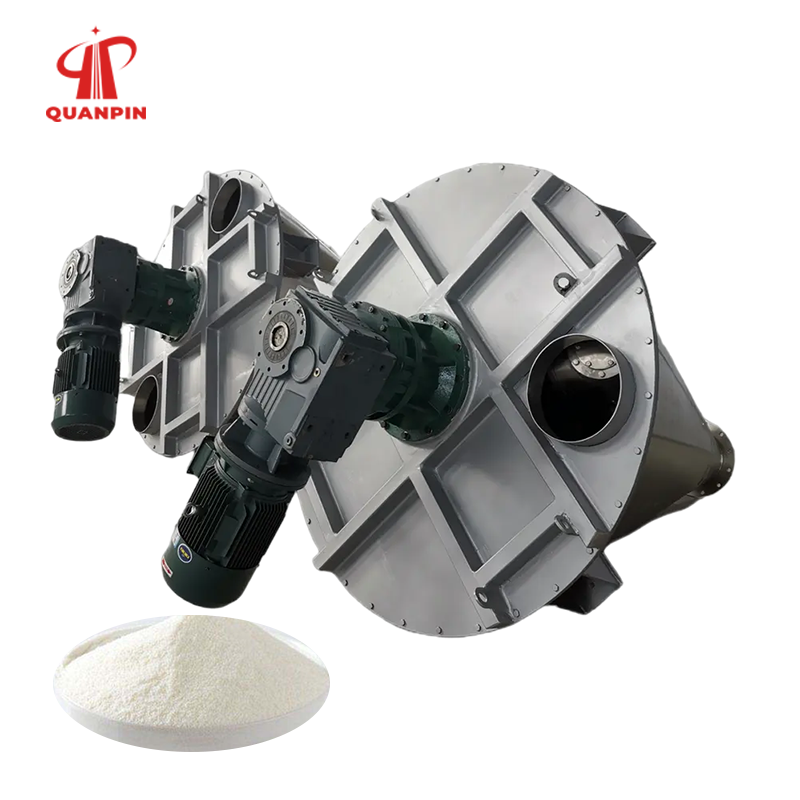
Five records needed before comparing moisture states
Ingredient identity
Identify every ingredient lot and its verified condition at receipt. Ingredient names alone do not describe the moisture history of the powder actually entering the mixer. Retain the available incoming results and mark missing data for investigation rather than filling gaps with published typical values.
Formulation basis
Record the formulation ratio on a consistent basis. A reliable weighing record supports the composition calculation, but it does not independently establish how water is distributed or associated with the different constituents after the powders are brought together in a blend.
Measurement temperature
Identify the temperatures relevant to the comparison. Include the material and measurement conditions as appropriate to the chosen method. A result reported without its method conditions is harder to compare with another result collected at a different stage or in a different laboratory.
Time and exposure
Define the time and exposure sequence between collection and measurement. A sealed retained sample, an open laboratory dish and a filled production package represent different histories. Record what actually occurred instead of treating their shared batch number as proof that the samples remained equivalent.
Separate endpoints
Choose separate endpoints for distribution and moisture behaviour. An ingredient assay can address composition at the chosen sample scale; a water-activity measurement addresses its own property under its method conditions. Each endpoint needs a stated purpose before either is used to judge the trial.
Why the incoming moisture average is incomplete
The original study of powdered-formula sorption investigates water activity, water content and glass transition together for identified mixtures and processed forms. Its material-specific approach supports measuring the relevant blend properties rather than assuming that an incoming moisture average completely describes the resulting powder.
An incoming moisture calculation can still be useful for a material balance when its inputs and basis are valid. The limitation is interpretive: a mass balance does not supply a general conversion into water activity for an arbitrary mixture of food powders.
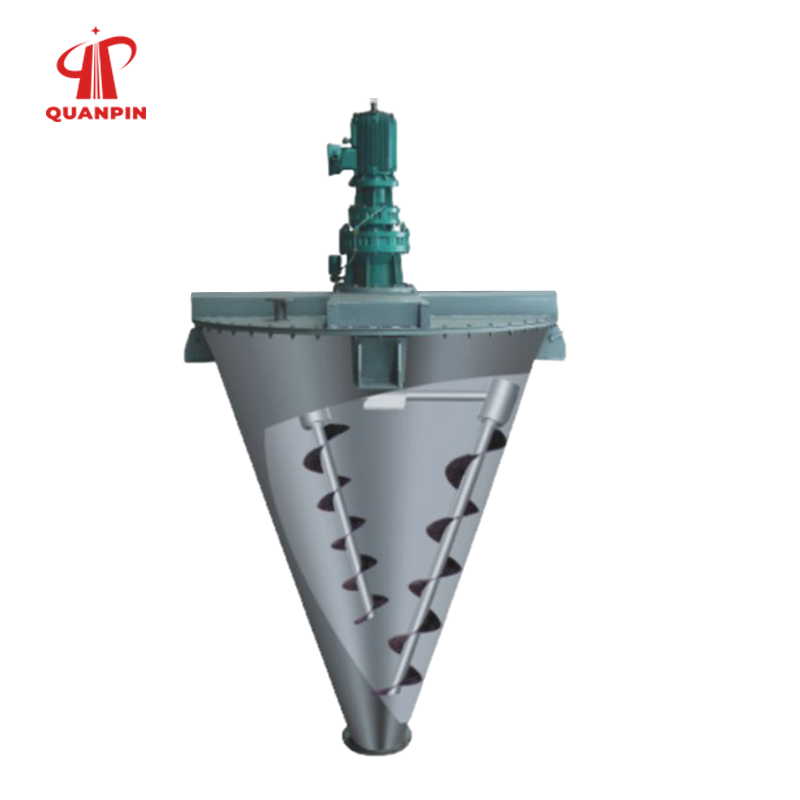
For a double screw cone mixer trial, keep formulation distribution evidence visible alongside moisture observations. If the two sets of results differ, investigate their separate purposes and methods before concluding that the mixing operation either succeeded or failed on an undefined combined criterion.
Avoid using one ingredient’s published sorption curve as though it represented the whole formulation. A blend may contain constituents with different interactions with water. Obtain evidence relevant to the actual mixture and measurement temperature before using a curve to support a development decision.

Build a time-labelled blend investigation
Define the material
Prepare a comparison using the real ingredient lots and intended formulation. List incoming information that is available and identify information still needed. The objective is to make any observed change interpretable without claiming a precision or completeness that the input records cannot support.
Identify initial collection
Label the initial collection point precisely. If the intention is to examine material at discharge, preserve that context through sample handling. Do not quietly add a laboratory holding step and describe its result as an instantaneous observation of the powder leaving the equipment.
Record retained conditions
Create a separate record for retained material. State the container, holding conditions and elapsed time selected for the investigation. These are trial conditions to be agreed and evaluated, not a generic instruction that every food powder should be conditioned in the same way.
Clarify repeated measurements
Ask the laboratory to use its appropriate method controls and to report relevant limitations. Specify whether repeated results come from the same prepared specimen or independently collected specimens. Those repetitions contribute different information when the team interprets an apparent change after holding.
Identify the package
Preserve the identity of the actual package or holding container being evaluated. The final commercial pack and a small laboratory container can have different exposure conditions. A result for one should not be presented as a direct shelf-life qualification of the other.
Review downstream use
Review the observations against the intended downstream use. A powder sent immediately to another operation may raise a different question from a blend stored before use. The comparison should explain the use being evaluated instead of presenting a generic claim that equilibrium is always the target.
Read moisture evidence within its material scope
Food-specific moisture relationships
The Manitoba agriculture guidance states that the relationship between water content and water activity must be established for the specific food. Its distinction supports reporting both quantities where relevant, without treating one as a universal substitute for the other.
For the actual formulation, state what each test will decide. Moisture measurement might support a composition or material-balance investigation, while water activity may support a product-specific stability assessment. Keep those decisions explicit so a convenient measurement does not acquire an unsupported additional purpose.
The guidance is educational and does not validate a particular dry blend or blending system. Do not copy a value from its general food tables into a purchase specification as though it were an acceptance limit for the actual ingredients and intended market.
Equilibrium and timing
The FAO discussion of water activity and equilibrium explains that foods can absorb or release moisture toward equilibrium with their environment and that equilibration times differ. This argues against assigning a universal post-mixing waiting period from the mixer cycle alone.
Translate that principle into a time-labelled investigation. Agree which observations are needed for the actual process, preserve their holding histories and compare results under identified measurement conditions. The schedule should answer the product question rather than merely match the availability of laboratory staff.
The FAO material concerns food preservation broadly. It does not demonstrate the time required for a particular powder mixture or a DSH machine. A development report should retain that scope and use actual blend observations to address its own timing question.
Material-dependent water transport
The original Wageningen research abstract on maltodextrin water transport describes experiments showing material-dependent transport and relaxation behaviour. It provides evidence that powder moisture behaviour can require a kinetic investigation, rather than an assumption of instantaneous equilibrium.
That investigation used specified maltodextrins and experimental conditions. It should not be read as a prediction of every food ingredient’s response. Its practical contribution here is to identify a question for testing when the actual formulation includes powders whose moisture state may evolve after collection.
Do not turn the research into a universal caking threshold or mixer setting. If the application has a flow or agglomeration concern, measure the relevant outcome for the actual blend. A water-activity observation alone should not be expanded into an untested statement about handling performance.
Connect the DSH proposal to actual handling
For a conical powder mixer proposal, provide the ingredient identities, available powder characteristics and expected post-discharge sequence. Ask QUANPIN to confirm the actual equipment arrangement and its suitability for the duty. Avoid assuming that a generic product-family description establishes every proposed handling feature.
Discuss the proposed collection arrangement before the trial. The development team needs to know where and when samples can be obtained and how they will be protected during transfer. Confirm the arrangement for the supplied configuration instead of inferring access details from a photograph.
Keep blending and drying claims separate in the specification. A double screw conical mixer enquiry should describe the real mixing duty; water removal or controlled environmental conditioning requires its own verified process provisions and evidence. Do not infer either function from the shape of the mixing vessel.
If a later result differs from the initial one, review the record before changing the mixing conditions. Check ingredient identity, measurement conditions, holding history and sample preparation. Increasing the cycle time cannot by itself resolve uncertainty about which part of the measurement chain produced the difference.
Distinguish shared water activity from equal water content
The University of California explanation of mixed-food equilibration notes that components can reach the same water activity while retaining different water contents. The distinction is useful when interpreting a mixed ingredient system, while its home-preservation examples do not prescribe industrial powder processing conditions.
An apparent moisture difference between ingredients therefore does not automatically demonstrate that the blend failed to distribute. Equally, a satisfactory composition result does not establish the final moisture state. Select additional observations according to the specific unresolved question and the intended product use.
Prepare the equipment and laboratory brief together
Build the enquiry around the real formulation and destination of the blend. State whether the product proceeds to further processing, temporary storage or final packaging. Each route gives a different context for deciding which immediate and later observations are necessary for the development programme.
Provide incoming moisture and water-activity results when available, with method identities and relevant conditions. If a supplier certificate lacks the information required for comparison, identify that limitation. Do not silently convert an incomplete incoming record into a definitive baseline for the entire trial.
Describe the expected exposure sequence after discharge. Include the actual transfer and holding arrangements proposed for evaluation. The equipment discussion becomes more useful when everyone understands whether the laboratory samples follow that sequence or a deliberately different comparison route.
Identify which containers belong to the study. A small sealed sample may be useful for a defined laboratory question, but it does not automatically reproduce the commercial package. Preserve that difference when deciding how far the resulting observations can be extended to production.
Agree the measurements and their decision rules before evaluating the results. The material owner should set product-specific acceptance responsibilities with appropriate expertise. The machine supplier can contribute equipment information without being asked to invent a food-safety limit from a general ingredient description.
Write down how further investigation will be triggered. An unresolved time trend may justify additional observation, while inconsistent replicate measurements may first require a method review. The next step should follow the evidence rather than an automatic assumption that longer blending is the remedy.
Interpret formulation and holding comparisons
When comparing alternative formulations, retain their individual identities and histories. A change in ingredient proportion can alter more than a distribution challenge. Treat the comparison as a new formulation investigation where appropriate instead of assuming the original blend’s moisture observations transfer unchanged.
When comparing holding times, preserve temperature and exposure records alongside the elapsed time. The label after mixing is insufficient if one specimen was sealed promptly and another remained open during preparation. The report needs enough detail to distinguish the actual conditions evaluated.
Preserve the conditions behind the conclusion
Retain individual measurements with the approved interpretation. A final average is easier to communicate, but the underlying identities and collection stages help a later reviewer understand the trial. Preserve any limitation that affects transfer of the result into the commercial handling sequence.
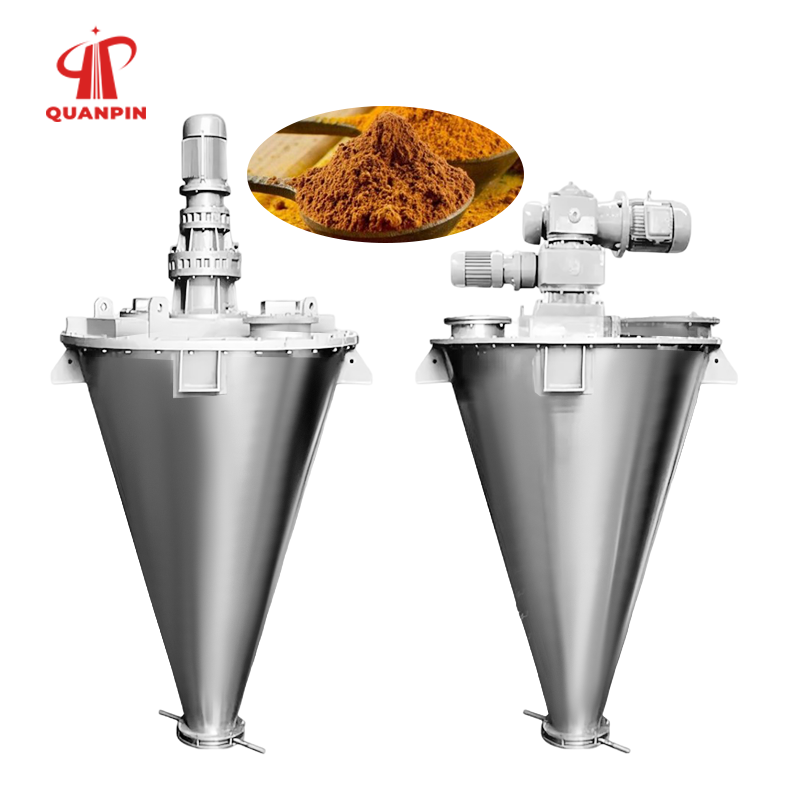
For a conical screw blender enquiry, connect the required distribution test to the real post-mixing moisture assessment. Ask for the actual DSH configuration and an agreed trial plan, then keep equipment acceptance and final food-product stability responsibilities explicit in the resulting documentation.
Frequently Asked Questions
Can moisture content predict blend water activity?
No. Total moisture and water activity describe different properties. A valid ingredient mass balance can support an incoming-water calculation, but it does not establish a universal conversion to the water activity of a mixed food formulation under all temperature and holding conditions.
Does the mixing cycle establish equilibrium?
No. Completing a mixing cycle does not independently demonstrate moisture equilibrium. Establish the conditions and timing relevant to the actual blend, then use suitable measurements. Published educational examples and research materials cannot supply a universal waiting period for every industrial formulation.
Must all ingredients reach equal moisture content?
No. Components at a shared equilibrium water activity can retain different moisture contents because their compositions differ. Interpret the measured quantity directly and avoid treating equal moisture percentages as a general requirement for a mixture to have reached an appropriate moisture state.
Does a retained sample represent the final package?
Not automatically. A small laboratory specimen and a commercial package can have different histories and environments. Identify what the retained-sample observation actually represents before using it in a product assessment. Packaging and shelf-life decisions require evidence relevant to the real product and conditions.
Does water activity establish complete safety?
Not by itself. Water activity is one relevant product property, while microbiological safety depends on the product-specific hazard assessment and controls. Do not present dry blending or a single water-activity result as a validated pathogen-reduction operation or a complete safety qualification.
What should the equipment enquiry contain?
Provide the actual ingredients, formulation, available incoming results and intended sequence after discharge. Ask QUANPIN to confirm the supplied DSH arrangement, then agree collection, holding and measurement responsibilities. Keep the final interpretation tied to the material and conditions actually evaluated in the trial.
Discuss Your Food Powder Mixing Duty
Discuss the material, processing objective and required trials with QUANPIN. Review the equipment information and the relevant industry applications, or send an enquiry through our contact page.
Email sales@qpdryer.com or stacie@qpdryer.com. Call +86 19850785582 or contact WhatsApp +86 15921493205 to discuss the proposed scope.