Conical Screw Mixer Trials: Define Uniformity at the Intended Test-Portion Mass
By QUANPIN
A powder blend can appear consistent when a laboratory tests a large portion and show substantial variation when the same material is tested in smaller portions. The practical question is therefore whether the chosen test portion represents the scale at which the material will actually be used.
For a conical screw mixer enquiry, include the intended analytical portion alongside the formulation and batch information. This makes the trial question concrete: demonstrate the specified property at a justified sampling scale, rather than ask for an undefined claim of perfect uniformity.
Define uniformity at the scale of use
Test portion means the quantity taken forward for a particular measurement. It is different from the amount initially removed from the mixer, the quantity delivered to the laboratory and the total batch. Each stage can have its own preparation and identification requirements.
An internally consistent report should identify these quantities separately. If several small increments are combined before analysis, the result describes that composite preparation; it cannot automatically reconstruct differences among the individual increments that were combined to make it.
Keep the measurement claim bounded
The smallest convenient laboratory portion is not automatically the most useful process test. It may answer a different question from a downstream operation that consumes larger quantities. Conversely, increasing portion mass can conceal variation relevant to a smaller intended application.
This article proposes a framework for chemical powder blending trials. It does not establish a minimum mass for any QUANPIN machine, certify a reference material or prescribe a statistical acceptance limit. Those decisions require the actual material, method and intended use.
Five facts that define a test portion
Measured property
Name the property being evaluated. A major ingredient assay, a trace element concentration and a particle size distribution are distinct properties. A satisfactory result for one does not establish that every other component follows the same distribution throughout the powder.
Analytical portion mass
Record the mass entering each analysis. Do not substitute container capacity or the nominal capacity of a sample scoop. Identify whether the laboratory weighs the complete submitted sample or withdraws a smaller portion after a separate preparation step.
Collection stage
Identify where the sample belongs in the process. An increment collected before discharge describes a different context from a filled package. Keep the location, collection sequence and intervening transfer operations attached to the sample identifier throughout the investigation.
Preparation route
Describe preparation before measurement. Crushing, dilution, dissolution or additional blending may change what the final test represents. A preparation route appropriate for total composition can remove information about the original distribution among particles or small portions.
Decision purpose
Define the decision that the measurement must support. A process-development comparison, a routine release decision and the production of a certified reference material have different responsibilities. Avoid presenting the same data as sufficient for all three purposes without justification.
Why portion mass changes the question
The NIST reference-material metrology guide explains that apparent homogeneity depends on portion size, the constituent and the measurement procedure. This supports defining the test scale before interpreting a powder result, rather than treating uniformity as an unrestricted property.
For an industrial trial, translate that principle into a written comparison. State the selected portion mass and the reason it represents the intended use. Preserve the distinction between evidence collected in that comparison and any broader claims the development team might wish to investigate later.
A larger portion and a smaller portion are not competing answers to the same unspecified question. They can be useful observations at different scales. Report the scale of each observation so a reader can understand whether the two tests address the same downstream requirement.
When a laboratory changes portion mass during development, record the change as part of the method history. Results produced before and after the change may need separate interpretation, especially when sample preparation or the measurement uncertainty also changes at the same time.
Plan the path from batch to analysis
Identify incoming material
Start with an identified incoming powder lot and a documented formulation. The purpose is to make a later difference interpretable. If the raw material changes together with the portion mass, it becomes harder to decide which change explains a different pattern of results.
Plan independent collection
Set out the original collection plan before selecting convenient specimens. Include the process stage and the intended number of independently collected samples. A collection plan should describe the material population of interest rather than merely the containers already available in the laboratory.
Preserve sample identity
Preserve independent sample identity through preparation. Combining specimens may be appropriate for a defined objective, but it changes the information retained. Keep a clear record of which increments were combined and which remained separately measurable during the comparison.
Separate measurement contributions
Ask the laboratory to explain the contribution of preparation and measurement to the observed spread. Repeated readings of one prepared solution investigate a different source of variation from independent powder portions prepared and measured separately from the beginning.
Retain individual observations
Choose a reporting format that retains individual results alongside justified summaries. A single average can be useful, but it should not remove the sample identifiers, test masses or preparation conditions needed to understand why the underlying measurements differ.
Review downstream use
Review the plan with the people responsible for downstream use. Their smallest relevant consumption unit may differ from the laboratory’s preferred amount. Resolve that difference explicitly instead of allowing the available analytical method to define the process objective by default.
Read reference-material evidence within its scope
Within-unit and between-unit evidence
The JRC certification record for ERM-FD104 and ERM-FD105 separates between-unit homogeneity, within-unit homogeneity and stability. Its stated minimum test amount belongs to those specific particle-size reference materials; it is not a general instruction for industrial powder blends.
The useful lesson for a development team is the separation of questions. Variation inside one collected container and variation between collected containers deserve identifiable observations. A test confined to one container should not be reported as though it covered the complete batch population.
Do not copy a published minimum amount into a mixer specification because both materials are powders. Composition, particle properties, the measured property and intended use can differ. Use the publication as an example of documented scope, then establish the scope for the actual duty.

Blending within material development
NIST’s original powder-reference-material abstract describes selection, blending, sampling and comparison of measurement techniques as parts of reference-material development. It illustrates why an equipment operation belongs inside a wider measurement programme rather than replacing that programme.
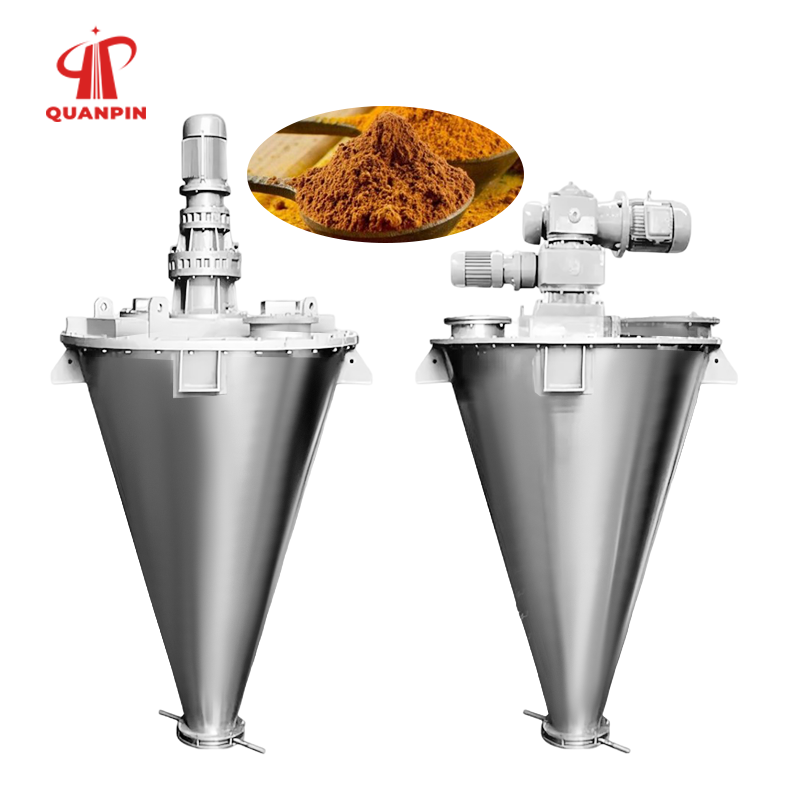
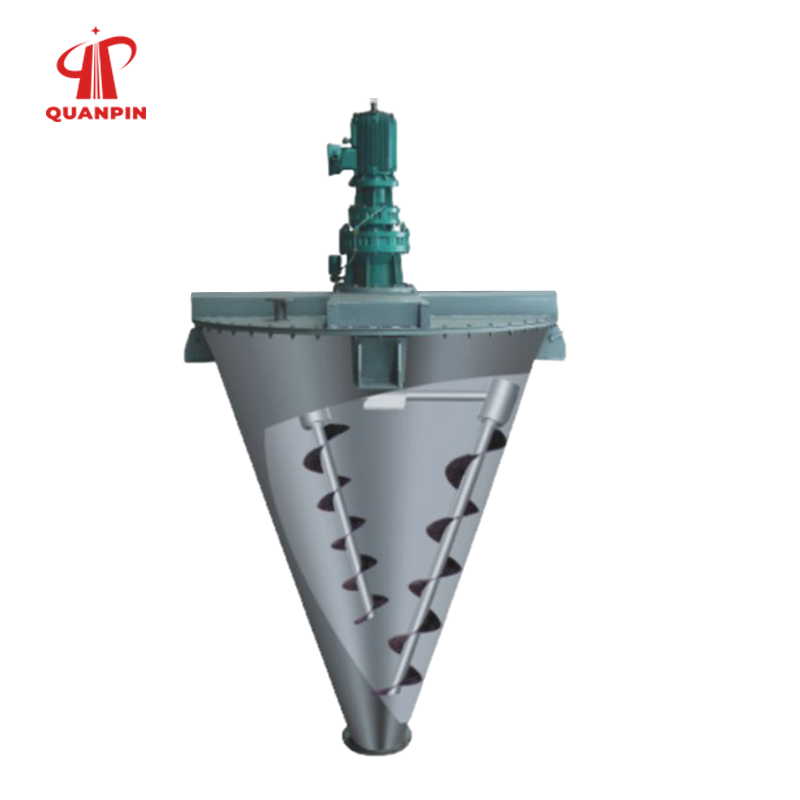
For a double screw cone mixer trial, keep the equipment record and laboratory record connected by batch identity. Record the actual supplied configuration and agreed operating conditions without assuming a published research material was processed on the same equipment.
The abstract concerns particle-size reference materials. It does not demonstrate composition uniformity for an unrelated formulation or qualify a particular machine. Maintain that boundary when borrowing the general development logic for an industrial procurement discussion or internal trial plan.
Sampling before characterization
The NIST particle-size characterization guide presents powder sampling as a planned sequence, including identifying the bulk material, choosing sample quantities, dividing samples and evaluating subsample homogeneity. This reinforces the need to document the whole path from batch to measurement.
Use that sequence as a review aid rather than a universal sampling recipe. Different analytical goals may require different preparation. The team should be able to explain how each collection and division step preserves the information needed for its particular decision.
The guide addresses particle-size characterization; its sampling discussion does not supply a ready-made composition acceptance criterion. A process engineer and laboratory analyst should jointly identify which parts are relevant before applying them to a chemical-powder mixing investigation.
Connect the DSH enquiry to the laboratory plan
For the actual conical powder mixer enquiry, describe the powder fractions, their verified characteristics and the intended downstream operation. Include available information about handling and collection. Leave unknown properties explicitly open for evaluation rather than filling the specification with assumed values.
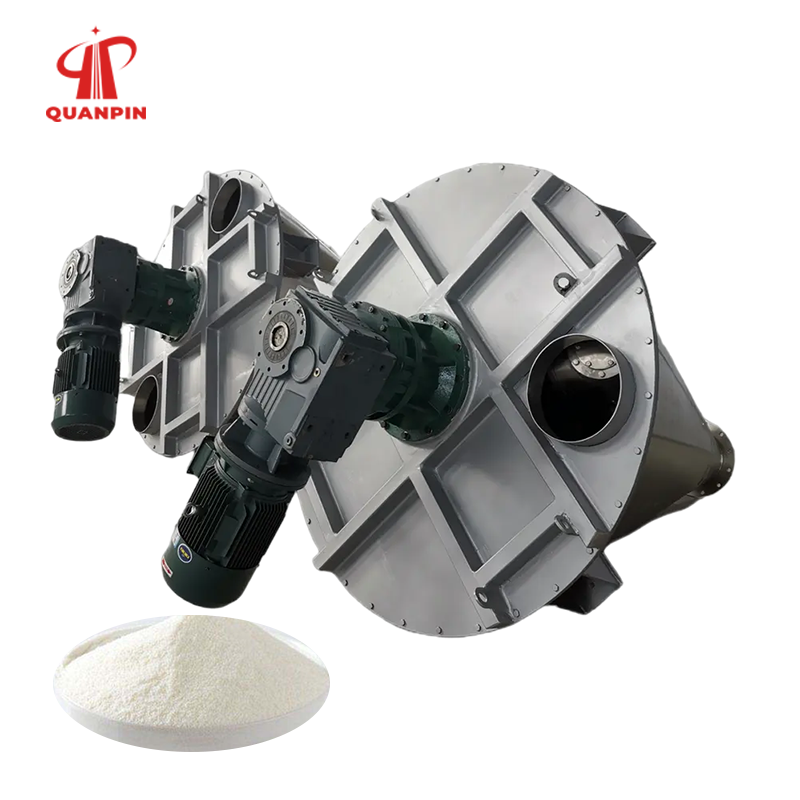
Ask QUANPIN to confirm which sampling access and discharge arrangements belong to the proposed configuration. A photograph or product-family description cannot establish that a particular access point is supplied or suitable for collecting a representative specimen during the proposed trial.
Keep any additional laboratory remixing visible in the report. If a submitted sample is homogenized again before analysis, the result may describe that prepared sample well while providing less direct information about the state originally obtained at the mixer discharge.
Retain the distinction between batch preparation and reference-material certification. A double screw conical mixer can be discussed as equipment for an identified duty, but the machine name alone does not establish metrological traceability, certified values or material stability during storage.
Keep certification responsibilities explicit
The NIST measurement-services quality manual treats reference-material homogeneity, stability, characterization and value assignment as documented responsibilities. Its homogeneity procedures are material-specific and fit for purpose; an industrial mixing comparison does not automatically fulfil that wider certification process.
Avoid describing an industrial comparison sample as certified simply because it was mixed and tested. If certification is needed, identify the responsible competent organisation and its applicable process. A process trial should state its own objective and limitations without borrowing a stronger designation.
Build a reviewable powder trial brief
Prepare the enquiry around a named material duty. Include the formulation basis, intended batch quantity, handling sequence, collection stage and proposed test portion. Explain the downstream requirement that makes that portion relevant, so equipment discussions remain connected to the measurement objective.
Attach the laboratory method identity where available. The supplier need not invent an assay to make an equipment proposal concrete, but the trial plan needs enough information to distinguish material distribution from uncertainty introduced during sample preparation or instrument measurement.
Provide the planned collection containers and sample labelling approach. Agree how samples will be protected and delivered to the laboratory. These are proposed organisational steps, not claims that a particular container or holding condition is suitable for every chemical powder.
State which comparisons will remain independent. For example, separate specimens can preserve collection-stage information that a composite would lose. If compositing is needed for another purpose, identify that purpose and retain a record of the constituents and amounts combined.
Specify how an inconclusive result will be handled. The next action might be a method review, further sampling or a revised trial, depending on the evidence. Do not assume that increasing mixing time resolves every unexpected laboratory result or every difference among portions.
Agree who approves the final interpretation. Equipment personnel, laboratory staff and the material owner contribute different information. A useful report makes their responsibilities visible and describes the evidence supporting the decision, including any unresolved limitation in sample representation.
Interpret comparisons at their actual scale
Compare alternative portion masses only under a defined investigation. Hold relevant preparation details consistent where possible and record unavoidable differences. The comparison should explain what each mass reveals about the intended use instead of ranking results by whichever produces the smallest spread.
If the intended application later changes to a smaller consumption unit, review the original evidence. A result at the previous scale remains an observation at that scale; the change in use may create a new question requiring additional material and measurement work.
Preserve evidence in the equipment specification
Retain the final agreed trial record with the equipment enquiry. This helps a later reviewer distinguish the conditions actually evaluated from optional configurations or operating ideas discussed during planning. A product-family name should not replace the particulars of the tested arrangement.
For a conical screw blender purchase discussion, ask for an equipment proposal linked to the documented powder duty. Keep acceptance criteria, sampling justification and laboratory responsibilities visible so the commercial specification and the technical evidence describe the same intended outcome.
Frequently Asked Questions
Does a larger portion prove better mixing?
No. A larger portion can average material over a different scale. Whether that is appropriate depends on the intended use and measured property. Select and justify the test portion before interpreting an apparently improved uniformity result as evidence of process improvement.
Is submitted sample mass the test portion?
No. The incoming laboratory sample may undergo division before measurement. Record the received amount, the preparation route and the actual analytical portion separately. Otherwise, a reader cannot determine which material quantity the reported result directly represents or reproduce the preparation.
Does one constituent represent every ingredient?
No. Distribution of one measured constituent does not establish distribution of every other constituent. Select properties relevant to the formulation and intended use, then define the scope of the resulting conclusion. Avoid extending a narrow result to unmeasured ingredients.
Can a reference-material minimum be copied?
Not automatically. A minimum amount in a reference-material certificate belongs to the identified material and specified measurement context. It is useful evidence of how scope can be documented, but it does not establish an amount for an unrelated industrial powder.
Are repeat readings independent powder tests?
Repeated instrument readings can help evaluate reading variability, while independently prepared portions include other contributions. They answer different questions. Ask the laboratory to identify which operations were repeated and preserve that distinction when describing the observed spread to the equipment team.
What belongs in the QUANPIN enquiry?
Provide the real powder formulation, downstream use, collection stage and proposed test portion together with the equipment duty. Ask QUANPIN to confirm the actual DSH configuration, then agree the trial and analytical responsibilities before drawing conclusions about distribution at the required scale.
Discuss Your Powder Sampling and Mixing Duty
Discuss the material, processing objective and required trials with QUANPIN. Review the equipment information and the relevant industry applications, or send an enquiry through our contact page.
Email sales@qpdryer.com or stacie@qpdryer.com. Call +86 19850785582 or contact WhatsApp +86 15921493205 to discuss the proposed scope.