Food Flour Milling Trials: Distinguish Particle Fineness from Measured Flow Behaviour
By QUANPIN
An air classifier mill trial should measure the handling property required after grinding rather than infer it entirely from fineness. A particle-size result is not a shear-cell flow function or a discharge demonstration.
For food flours, define both the collected powder and the subsequent handling question. Different flow tests impose different conditions, so their results need an explicit interpretation.
Measure the Required Handling Property
An angle of repose describes the geometry formed in its particular test. It does not directly measure the strength of a consolidated powder bed.
Bulk and tapped density provide another physical comparison. Their associated indices do not automatically replace measurements under defined stress.
Define What Each Test Represents
A shear-cell assessment examines a powder under specified loading and preparation conditions. Its represented state differs from a freely formed pile.
Choose the test according to the required handling question. Avoid treating one convenient number as a universal specification for every downstream operation.
Five Inputs for a Powder Comparison
Food identity
Identify the grain and flour preparation. Different compositions can produce different bulk responses even when median particle sizes are similar.
Collected distribution
Record the actual particle distribution and collected fraction. A single average can conceal changes in the fine and coarse populations.
Specimen condition
State the moisture condition and any conditioning before analysis. Keep the specimen history distinguishable from a change produced by grinding.
Test method
Document the test apparatus and preparation. Results obtained under different stress histories may answer different questions.
Handling objective
Describe the intended transfer or dosing operation. An analytical comparison should resolve a defined material-handling need rather than rank powders abstractly.
Read Milling Evidence within Scope
An original rice-flour milling investigation compared Carr flowability and floodability indices alongside moisture and particle characteristics for flours from different milling routes.
Its results concerned both the material and the preparation route. They do not establish that every finer food powder has the same handling response.
Jet and hammer preparations also involve different histories. The findings should not be copied as settings or flow guarantees for QUANPIN equipment.
Use the study to retain more than diameter in the acceptance question. Confirm the relevant measurements on the collected material from the proposed trial.
Six Stages Preserving Sample Context
Incoming lot
Before grinding, identify the incoming lot and its condition. Preserve those records when the collected flour is later compared.
Trial collection
During the trial, record the actual arrangement and collection basis. A different recovered fraction may have different bulk properties.
Conditioning
During specimen preparation, maintain the agreed conditioning. Unrecorded moisture changes can complicate interpretation of a flow result.
Rapid tests
During rapid testing, preserve the method rather than reporting only a descriptive grade. The meaning depends on the measurement procedure.
Shear tests
During shear testing, retain the loading and preparation history. The laboratory should define which conditions represent the intended handling question.
Acceptance review
During acceptance, review the particle and handling results separately. A useful conclusion identifies which requirement the trial actually demonstrated.
Retain Stress and Material Histories
Loading and vibration
The same flour can change its measured response after loading, vibration or storage. That history belongs beside the result.
An original wheat-flour consolidation experiment evaluated compressibility, cohesion, permeability and wall friction after normal loading and vibration.
The measured responses differed between soft and hard flour. Its findings do not supply a universal correction that converts fresh powder tests into stored-powder behaviour.
Time consolidation
Time and conditioning can also alter the state represented by a shear measurement. A fresh specimen and a consolidated specimen are not automatically equivalent.
An original wheat-flour water-activity study compared instantaneous and time-dependent flow functions under controlled stress and storage conditions.
This supports documenting the state in which the powder was assessed. Its experimental durations and humidity conditions are not operating specifications for a proposed mill.
Comparing flow methods
Comparing test methods on multiple ingredients can reveal why a simple ranking needs care. The method itself contributes to what the result describes.
An original plant-food-powder investigation compared Hausner ratio, Carr index, dynamic angle of repose and annular-shear measurements across several plant powders.
The authors evaluated the methods’ applicability and noted that some could mislead. Similar rapid indices should therefore not independently establish equivalent stress-dependent flow behaviour.
Compare Results in a Useful Order
First compare the collected materials using the same size-reporting basis. Retain the distribution rather than relying on a nominal fine-powder description.
Then compare the rapid tests under matched preparation. A change in filling or tapping procedure can complicate a numerical comparison.
Where the handling question requires it, obtain stress-dependent measurements. Keep the specimen and loading history attached to the reported result.
Finally relate the laboratory evidence to the intended operation. A laboratory classification alone does not demonstrate every transfer, storage or discharge arrangement.
Identify Separate Formulation Changes
An original food-flow-additive experiment measured coated food powders with a ring shear tester after a separate particle-coating stage.
Its formulation modification illustrates another influence beyond particle dimensions. Spray drying and coating were separate research operations, not demonstrated functions of the proposed fine grinder.
Investigate Contrasting Findings
If fineness improves but a handling result worsens, retain both findings. Greater size reduction does not automatically resolve the downstream requirement.
If rapid indices agree but shear results differ, examine the imposed stress and specimen histories before dismissing either observation.
If fresh and stored specimens differ, report the conditioning and duration. Do not attribute the entire change to milling without that comparison.
If moisture changes between tests, resolve the reporting and conditioning difference before assigning a mechanism to particle size alone.
If a flow aid changes the outcome, identify the formulation change explicitly. The result cannot be described as an effect of grinding alone.
If the trial does not reproduce the intended handling operation, state that limitation. A favourable laboratory value is evidence within its actual scope.
Prepare the Milling Enquiry
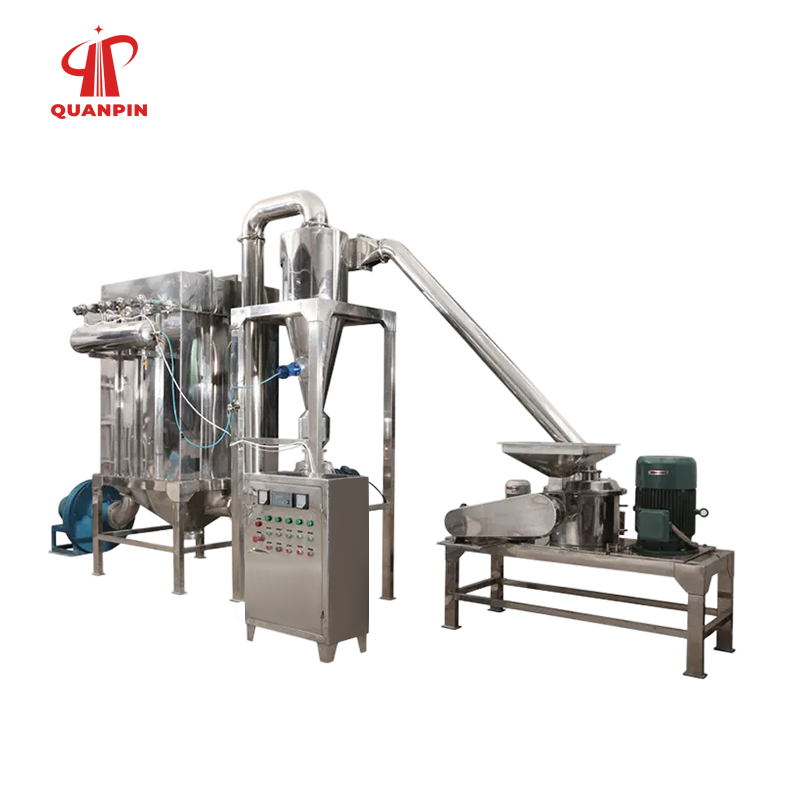
For an air classifying mill enquiry, provide food identity, incoming condition and desired distribution. Add the handling property that the collected powder must demonstrate.
For an ACM mill comparison, retain the same collection and analytical basis. Define the responsibilities for conditioning, rapid tests and any separate shear assessment.
Confirm Equipment and Test Scope
Review the fine powder grinder duty against the actual food ingredient. Confirm the supplied arrangement and representative material-trial scope with QUANPIN.
A useful quotation distinguishes size reduction from downstream handling evaluation. It should not guarantee universal free flow or hopper performance from an untested particle target.
Frequently Asked Questions
Does fineness establish flow?
No. Size and bulk handling are different observations. The required flow test should represent the particular downstream question.
Does repose angle describe consolidation?
No. Repose angle describes its test geometry. It cannot independently establish the strength of a consolidated powder bed.
Are all indices interchangeable?
No. Rapid density-based indices and shear measurements impose different conditions. Preserve their methods and limitations.
Does a fresh test describe stored powder?
No. Loading, vibration, moisture and storage can change the represented powder state. A fresh measurement does not automatically describe all later conditions.
Does coating prove grinding improvement?
No. A coating or additive experiment includes a separate formulation operation. Its improvement is not a grinding-only performance guarantee.
What should the enquiry specify?
Provide the ingredient, lot condition, distribution target and handling objective. Agree the laboratory methods and actual trial conditions before interpreting acceptance.
Discuss Your Food-Flour Trial
Discuss the material, processing objective and required trials with QUANPIN. Review the equipment information and the relevant industry applications, or send an enquiry through our contact page.
Email sales@qpdryer.com or stacie@qpdryer.com. Call +86 19850785582 or contact WhatsApp +86 15921493205 to discuss the proposed scope.