V-Blender Investigation: Distinguish Particle Tracking from Concentration Evidence
By QUANPIN
A V blender flow experiment and a pharmaceutical concentration test answer different questions. Tracking a moving particle does not independently establish the ingredient distribution of the surrounding mixture.
Use particle-motion evidence to investigate transport mechanisms, while preserving a separate analytical basis for composition. A useful development study connects these observations without treating them as interchangeable.
Define the Measurement Question
Positron emission particle tracking, or PEPT, follows a suitably labelled tracer inside the studied apparatus. Its trajectory provides information about movement under the experimental conditions.
A concentration measurement describes the amount of a selected component represented by its specimen or analytical field. It requires a sampling and analytical method suited to that component.
Separate Motion from Composition
A circulating tracer can repeatedly visit several regions while component concentrations remain uneven. Conversely, a concentration result cannot reconstruct every particle’s previous route through the vessel.
For a V mixer enquiry, identify whether the unresolved question concerns circulation, transport between regions, or formulation composition. Specify the evidence required for that question.
Record Five Evidence Inputs
Experimental material
Record the experimental material and its relevant physical condition. A tracer in cohesionless beads does not automatically represent a cohesive pharmaceutical powder.
Tracer representation
Identify what the tracked particle represents and how it differs from the surrounding material. Representativeness is part of the interpretation, not an assumption supplied by the tracking technique.
Research apparatus
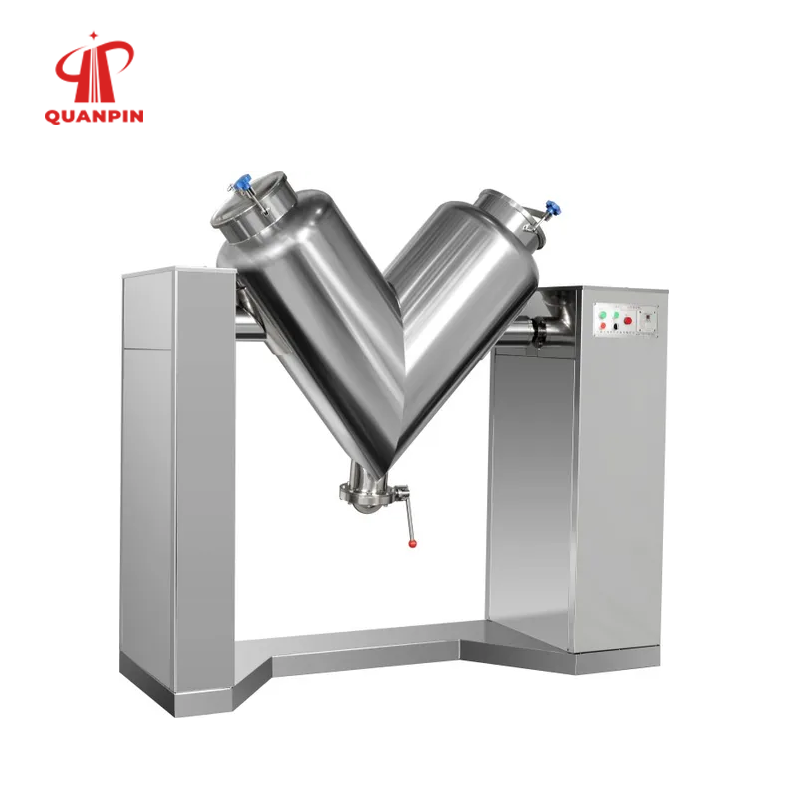
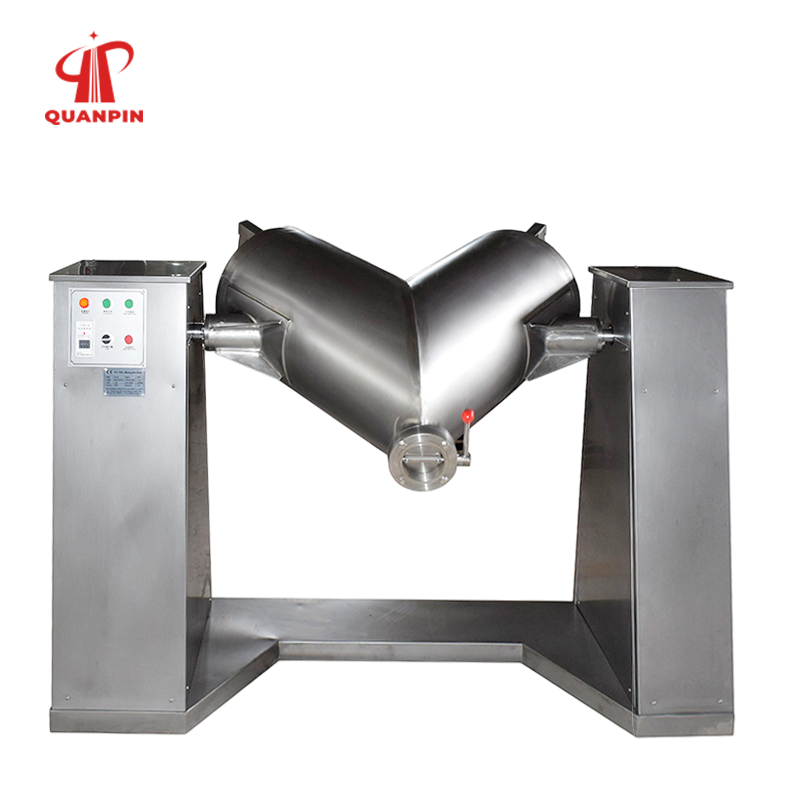
Describe the apparatus used for the observation. A research vessel and the proposed production machine may share a category name while differing in important details.
Observation and analysis
Preserve the measurement window and processing method with any trajectory interpretation. An extracted velocity or circulation description belongs to the stated analysis.
Composition evaluation
Keep the composition evaluation plan separate. Identify the component, specimen collection and analysis before relating concentration findings to a movement hypothesis.
Understand What PEPT Observes
Original V-mixer research used PEPT to investigate circulation of cohesionless particles. It distinguished surface flow, solid-body motion and circulation within the vessel arms.
The university particle-tracking study supports asking which movement is actually measured. Its glass-bead experiment did not validate a pharmaceutical formulation.
This distinction is useful when a V cone blender investigation appears to show vigorous movement. Visible or tracked motion is evidence about motion, not an independent composition acceptance test.
Keep the study’s material boundary explicit. Do not transfer tracer observations into a promise about a different ingredient’s distribution or the quality of finished dosage units.
Follow Six Investigation Stages
Material preparation
At material preparation, identify the mixture and model particles. A simplified material can answer a mechanistic question without representing every intended product interaction.
Tracer selection
At tracer selection, describe the rationale for the selected particle. A tracer’s path is informative only within the interpretation justified for that experiment.
Equipment review
At equipment review, record the actual configuration. Do not describe a research detector arrangement as a feature supplied on standard QUANPIN equipment.
Observation
At observation, retain the measurement method and actual events. An interruption or changed preparation can affect how different observations should be compared.
Motion analysis
At analysis, distinguish trajectories from derived quantities such as velocities or circulation patterns. Each additional calculation introduces its own interpretation requirements.
Formulation evaluation
At formulation evaluation, preserve specimen and analytical identities. Composition results should remain traceable independently of a convenient movement illustration.
Connect Complementary Measurements
Identify observed quantities
A V type mixer investigation can use both measurements in a complementary way. A flow hypothesis may suggest a collection question that is then assessed analytically.
Avoid selecting only the most visually persuasive track. Establish how the observations support the stated question before choosing an illustrative example.
If results differ between repeats, preserve their actual conditions. A difference warrants investigation rather than an automatic explanation based on one attractive flow pattern.
Define validation scope
Specify which part of the interpretation comes from an observation and which part comes from a model. A predicted particle route is different evidence from a measured trajectory.
Where a model is compared with an experiment, identify the observable used for that comparison. Agreement in circulation does not necessarily validate concentration predictions.
Keep particle representation and material assumptions with the result. A model of idealised particles should not silently become a description of the customer’s whole formulation.
Retain material assumptions
A pharmaceutical V-type lubricant study compared material and later tablet properties with proposed particle-travel measures. Its original experimental comparison illustrates the need to test a motion-related metric against the intended outcome.
Here its relevance is the relationship between a proposed explanatory quantity and measured properties. This article supplies no scaling criterion or programme for another blender.
A transport measure and an analytical result can be correlated in a defined experiment without becoming universally interchangeable. Preserve both the tested relationship and its limits.
Evaluate Motion-Related Indicators
A V powder blender investigation should therefore state what evidence would contradict the preferred interpretation. Retaining disagreement makes a mechanism assessment more useful.
An original powder-mixing research programme examined segregation behaviour and developed models involving tumbling systems. Its public annual research summary supplies mechanism context rather than a pharmaceutical acceptance standard.
Segregation research reinforces why repeated circulation does not settle every composition question. Particle characteristics and the studied flow environment remain relevant.
Different models may also report different indicators of mixing. Compare the quantity actually calculated rather than assuming that a shared label represents the same measurement.
Keep Research Metrics Explicit
An original study used PEPT in a pharmaceutical continuous-direct-compression blender to derive particle-motion metrics. The university study of an inclined continuous blender connected the tracked dynamics with questions about predicted mixing performance. Its continuous geometry differs from a batch V-blender, so its operating relationships do not prescribe V-blender settings.
An original study of pharmaceutical powder flow used PEPT in a continuous blender to examine particle paths, axial dispersion and residence time. Its author-university research record shows why related motion measurements still describe different quantities.
Investigate Disagreement between Methods
A continuous impeller mixer is not a batch V-blender. These measurements explain the importance of defining the observable; they do not validate a V-blender formulation or establish a transferable operating setting.
If particle tracking suggests circulation but composition findings disagree, investigate both methods and their material basis. Do not discard one simply because another provides a clearer image.
If composition appears consistent, avoid reconstructing an unmeasured trajectory from that result alone. The analytical finding answers its defined question without proving every mechanism.
Prepare an enquiry with the actual formulation and the unresolved measurement question. Explain whether specialist tracking, representative sampling or another investigation is proposed.
Ask QUANPIN to confirm supplied equipment interfaces and responsibilities. Specialist PEPT research requires its own suitable facilities and expertise; do not imply it is a standard machine function.
All observation and sampling must follow agreed safe arrangements. Do not open operating machinery or improvise access to observe the powder bed.
Prepare the Measurement Enquiry
Retain measured results, derived quantities and model assumptions as distinguishable parts of the study. This helps reviewers understand which conclusions each part supports.
Record unanswered questions before adopting an interpretation. A precise limit is more useful than describing motion and concentration as equivalent evidence.
Retain the Evidence Boundaries
Discuss your V-blender development question with QUANPIN through the verified product and contact links below. Explain which movement or composition evidence is required.
A useful investigation connects particle-transport questions with the right measurements. It preserves the distinction between observed motion and demonstrated formulation composition.
Frequently Asked Questions
Does particle tracking establish concentration?
No. A tracked particle demonstrates its observed movement under the experiment’s conditions. Ingredient concentration requires an appropriate independent analytical basis.
Does one tracer represent every ingredient?
No. Its representativeness depends on the material and research design. Differences between tracer and formulation need an explicit applicability assessment.
Is velocity a concentration measurement?
No. A derived velocity describes a motion quantity. It does not independently specify component concentration or pharmaceutical acceptance.
Can simulation replace validation?
No. A simulation supplies predictions under its assumptions. Validation must address the particular observable and intended use.
Does circulation establish finished-product quality?
No. Motion, composition and finished-product attributes are distinct questions. Each requires evidence appropriate to the actual development objective.
What supports a measurement enquiry?
Provide the formulation, material condition, apparatus description and unresolved question. Identify proposed methods, specialist responsibilities and the conclusions each observation must support.
Discuss Your V-Blender Investigation
Discuss the QUANPIN V series mixer with QUANPIN. Use our contact page or the enquiry form to explain the intended material-processing application.
Email sales@qpdryer.com or stacie@qpdryer.com. Call +86 19850785582, or contact us on WhatsApp: +86 15921493205.