Vacuum Drying vs Freeze Drying: A Practical Guide to Choosing Your Process
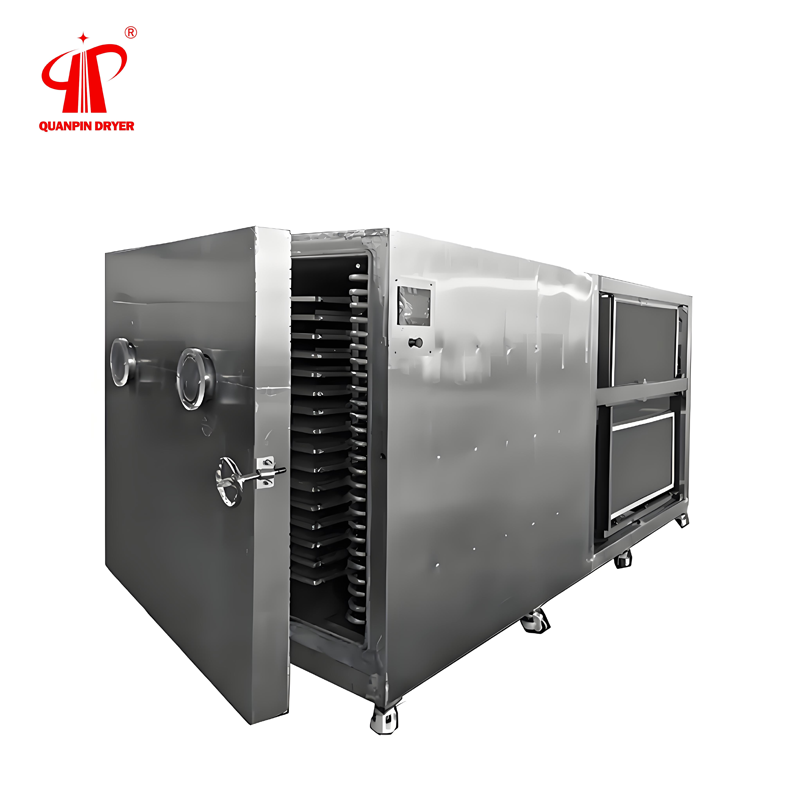
The right drying process starts with the finished product you need. Are you producing a powder that will be milled and blended, a food ingredient that must rehydrate quickly, or a material with strict temperature limits? Vacuum drying and freeze drying both use reduced pressure, but their process routes and equipment requirements differ.
This guide explains the distinction and provides a practical checklist for discussing your application with QUANPIN. Equipment selection should be based on material trials and a defined product specification, rather than the process name alone.
How the Two Processes Differ
In conventional vacuum drying, moisture evaporates from a material under reduced pressure. Lower pressure allows a liquid to boil at a lower temperature than at atmospheric pressure. Heat is still required, and the appropriate operating conditions depend on the material and the liquid being removed.
Freeze drying, also called lyophilization, begins with freezing. During primary drying, ice passes directly into vapor under controlled vacuum and heat input. Secondary drying removes additional residual moisture. A freeze dryer therefore needs coordinated refrigeration, heating, vacuum and vapor collection systems.
Compare the Requirements Before Choosing
| Selection question | Conventional vacuum drying | Freeze drying |
|---|---|---|
| Starting condition | Usually an unfrozen wet material | A frozen product before primary drying |
| Main removal mechanism | Evaporation | Ice sublimation, followed by residual moisture removal |
| Product specification | Assess drying uniformity, agglomeration and final handling | Assess structure, collapse risk and reconstitution |
| Equipment discussion | Heating surfaces, loading, agitation and vapor handling | Freezing capacity, shelf control, condenser and cycle design |
| Economic comparison | Calculate cost per acceptable batch | Include freezing and the complete drying cycle |
When to Evaluate Conventional Vacuum Drying
Begin with vacuum drying when your material can tolerate the proposed thermal exposure and the final specification does not require a freeze-dried structure. Discuss whether the product is a paste, wet powder, granule or solid piece, and whether agitation is acceptable.
For tray-based processing, explore a square shape vacuum dryer. For suitable materials that benefit from mixing during drying, discuss a vacuum harrow rake dryer. These are starting points for an engineering review, not interchangeable choices for every feed.
When to Evaluate Freeze Drying
Consider freeze drying when preservation of product structure or reconstitution behavior is central to the specification. The product must also tolerate freezing. Do not assume that low-temperature processing guarantees complete preservation of every quality attribute.
Share sample characteristics and acceptance criteria when reviewing QUANPIN freeze drying equipment. Ask how loading depth, freezing conditions and the drying endpoint will be established for your material.
Compare Complete Batches, Not Just Drying Time
Request a comparison that includes loading, preparation, drying, unloading and cleaning. Record saleable output per batch, utility consumption, labor and any losses. An attractive chamber capacity does not by itself establish daily production.
Use the same final product requirements when comparing proposals. A faster cycle is only useful if the resulting material meets your moisture, appearance, flowability or reconstitution targets. Confirm which requirements will be measured during trials and how samples will be taken.
Prepare These Details for an Equipment Inquiry
Provide the material name and composition; initial and target moisture with the measurement basis; wet feed per batch; intended daily output; maximum acceptable product temperature; and the desired physical form after drying.
Also describe available utilities, installation space, cleaning expectations and any solvent present. If the feed contains solvents, request a separate compatibility and safety review of the proposed system. Include photographs or sample test results where available.
Frequently Asked Questions
Is every vacuum dryer a freeze dryer?
No. Both may use vacuum, but freeze drying requires a frozen product and equipment designed for sublimation. An ordinary vacuum drying chamber should not be assumed to perform a validated freeze-drying cycle.
Which method is better for my product?
Define the quality targets first, then compare trial results and production costs. Neither method is universally best for all foods, chemicals or other materials.
Discuss Your Drying Application with QUANPIN
Use the inquiry form alongside this article to share your material and capacity requirements, or contact QUANPIN. You can also message our team on WhatsApp: +86 15921493205.
Technical background: BUCHI: freeze-drying principles. Process descriptions are general; application settings require material-specific evaluation.