Spray Dryers Explained: Process, Equipment and Selection
By QUANPIN
Turning a liquid formulation into a useful powder takes more than removing water. The finished material must also meet requirements for moisture, particle size, handling and stability. A spray dryer combines droplet formation and evaporation in one continuous process, making it an option for many pumpable feeds.
This guide explains the equipment and the questions to resolve before selecting a system. Explore QUANPIN’s centrifugal spray dryers and pressure spray dryers, or discuss your formulation with our team.
What Does Spray Drying Do?
Spray drying converts a liquid solution, suspension or emulsion into particles by dispersing the feed into a heated gas stream. The liquid phase evaporates while the nonvolatile solids become the powder product. Feed properties and operating conditions determine whether that powder is suitable for its intended use.
A spray dryer is therefore both a dryer and a particle-forming system. Changing how the feed breaks into droplets can change the resulting particle distribution. A successful specification starts with the required powder properties, rather than selecting equipment by chamber size alone.
How the Process Works
A feed pump delivers material to an atomizer. The atomizer creates a spray inside the drying chamber, where a controlled gas stream supplies heat for evaporation. The system then separates powder from the gas and transfers it to a collection or downstream handling stage.
The inlet gas temperature is not the same as the temperature experienced by every particle. Evaporation cools wet droplets, while particles become more sensitive to heating as they dry. This is why inlet temperature, outlet temperature, feed rate and residence time must be evaluated together.
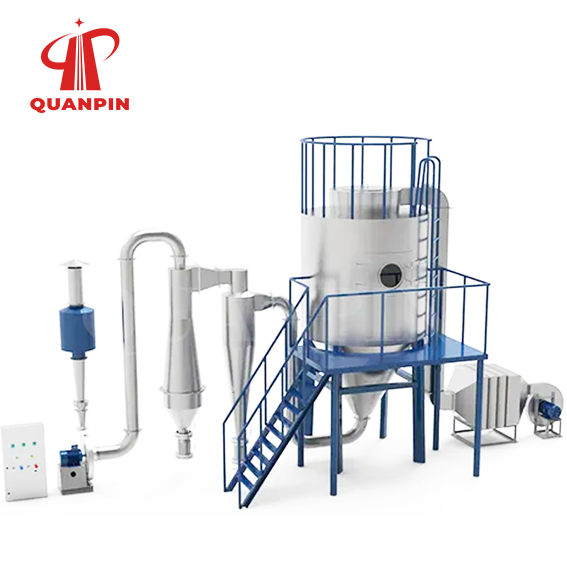
From Liquid Feed to Finished Powder
1. Prepare a Consistent Feed
Record the solids concentration, viscosity, density and solvent composition. Check whether suspended solids settle, whether a filter is needed before the atomizer, and whether heating or agitation changes the formulation. Consistent feed conditions make the drying response easier to control.
2. Create the Droplet Distribution
Choose an atomization method that suits the throughput and formulation. Droplets do not all have the same diameter. Their distribution affects drying time, wall deposition and the amount of fine powder that must be recovered.
3. Bring Droplets into Contact with Drying Gas
The air distributor and chamber geometry guide the interaction between gas and spray. Poor distribution can create local wet zones or push material toward the chamber wall. The design should be assessed with the selected atomizer and expected operating range.
4. Evaporate the Liquid and Form Particles
As solvent leaves each droplet, its solids concentrate and develop into a particle. Formulation and drying history influence particle structure. A powder that appears dry may still need testing for residual moisture, flowability, solubility or other application-specific properties.
5. Separate, Cool and Collect
Powder recovery may use a chamber outlet, cyclone, filter or a combination of devices. Subsequent cooling and moisture-resistant handling can be important before packing. Collection efficiency and the condition of the finished powder should both be included in acceptance criteria.
Four Stages to Check During a Trial
Atomization: confirm stable feed delivery and a repeatable spray pattern across the intended operating range.
Drying: compare feed rate and temperature settings against measured product moisture and quality.
Separation: account for powder collected in the chamber, cyclone, filter and any deposits when calculating recovery.
Collection: check whether the powder bridges, cakes, absorbs moisture or needs cooling before packaging.
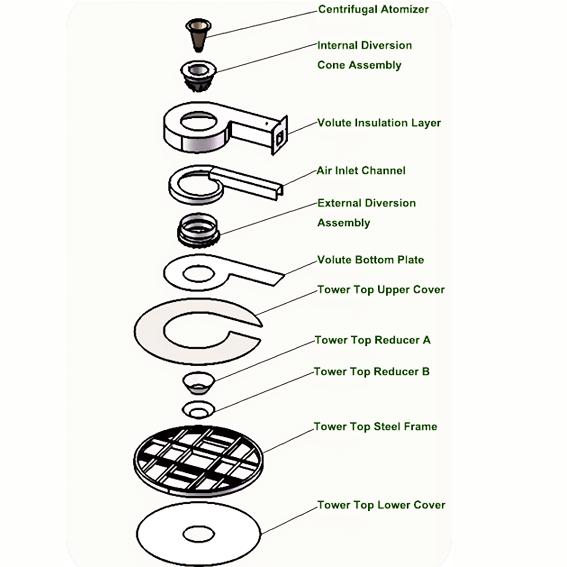
Main Equipment in a Spray Drying Line
Feed Vessel and Pump
The feed vessel provides a controlled supply to the dryer. Pump selection depends on viscosity, required pressure, flow range and compatibility with the material. Feed-system stability is particularly important when the process is sensitive to small changes in loading.
Atomizer
A rotary atomizer uses a rotating element to disperse the feed. A pressure nozzle uses liquid pressure, while a two-fluid nozzle uses a separate atomizing gas. Each approach has different maintenance needs and utility requirements.
Drying Chamber and Air Distributor
These components provide space and a flow path for evaporation. Their selection is connected to droplet size, powder behavior, gas volume and acceptable deposition. Access for inspection and cleaning deserves attention at the design stage.
Heating and Air-Handling System
The heating arrangement must match the available utilities and the product’s requirements. Air filtration, fans, ducting and temperature measurement are also part of the process. Requirements for hygienic handling or solvent service can significantly change the design.
Powder Recovery and Discharge
Recovery equipment must handle the expected particle distribution and operating conditions. Discharge arrangements should avoid unnecessary exposure to ambient moisture and allow practical cleaning between campaigns.
Controls and Instrumentation
A useful control specification identifies the variables to measure, alarms to provide and conditions that require shutdown. It should also define which operating and quality data must be recorded for production review.
Common Spray Dryer Configurations
By Atomization Method
Pressure nozzle: useful when a pressure-driven spray is appropriate for the feed and powder target. Review nozzle wear, blockage risk and pump requirements. See the QUANPIN pressure spray dryer page.
Two-fluid nozzle: uses atomizing gas as well as liquid feed. It is commonly considered for development work and smaller throughputs; gas consumption and product recovery remain selection factors.
Rotary atomizer: offers another way to control droplet formation in continuous processing. Selection should consider feed characteristics and the required operating range. See centrifugal spray drying equipment.
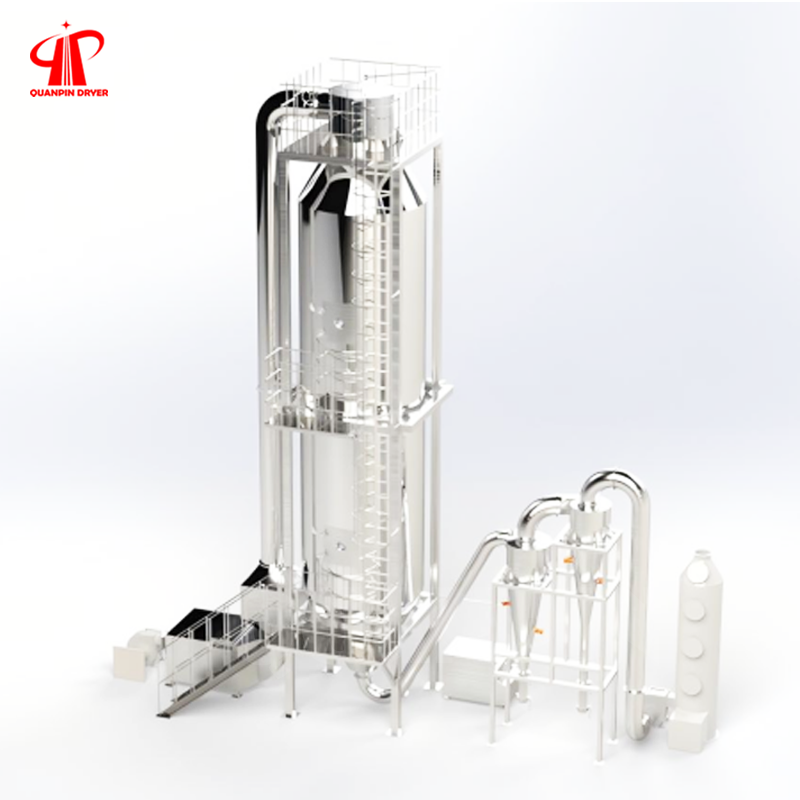
By Gas and Feed Direction
Co-current: gas and spray initially travel in the same general direction. This brings the wet feed into contact with the hottest incoming gas.
Counter-current: gas and material follow opposing overall directions, changing the particle’s temperature history. Suitability depends on product tolerance and the intended process.
Mixed flow: combines flow directions within the chamber. Chamber geometry and spray direction need to be assessed as a system rather than as independent features.
Special Process Arrangements
Closed-cycle systems recirculate a process gas and may recover solvent through condensation. Solvent properties, oxygen limits and gas treatment determine whether such an arrangement is appropriate.
Reduced-pressure systems operate under different pressure conditions and require a purpose-designed process. They should not be treated as interchangeable with conventional atmospheric spray dryers.
Multi-stage systems divide drying or finishing between stages. An additional stage can also serve a powder-conditioning objective, but its benefit must be weighed against cleaning, space and control requirements.
Where Spray Drying Is Used
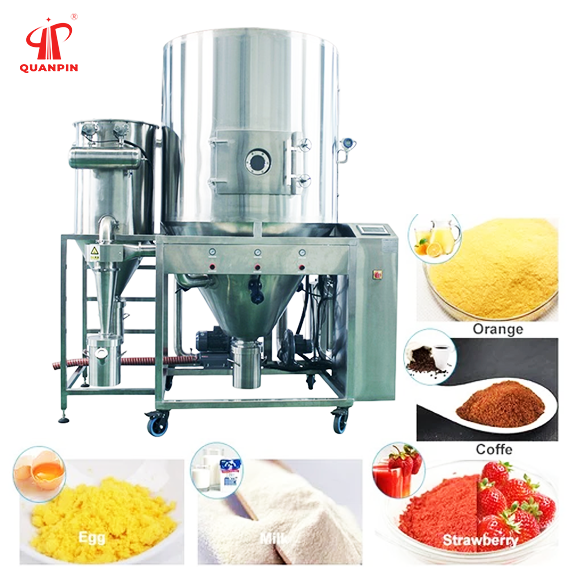
Food ingredients: evaluate dispersibility, flavor retention, moisture and hygienic requirements. Visit our food drying applications.
Pharmaceutical materials: define the required particle attributes and validation strategy before choosing a process. Learn about pharmaceutical drying applications.
Chemical products: consider corrosion, solvent compatibility, dust behavior and containment. See chemical drying applications.
Biological formulations: suitability depends on the formulation and the activity that must remain after processing. Drying trials and appropriate analytical tests are essential; thermal exposure alone does not predict the final result.
Benefits and Practical Limits
Spray drying can combine liquid drying and particle formation in a continuous operation. It also provides several process variables for adjusting powder characteristics. However, it requires energy, gas handling and suitable powder recovery equipment.
Sticky formulations, highly viscous feeds and materials with a narrow stability window can be difficult to process. Feed preparation or a different drying method may be more suitable. Trial results should establish the acceptable operating window before production equipment is finalized.
Factors That Influence Performance
Feed solids and viscosity: higher solids can reduce the amount of liquid that needs evaporation, but the feed must remain pumpable and suitable for atomization.
Gas temperatures and humidity: these affect drying capacity and product exposure. Final moisture must be measured rather than inferred from a single temperature reading.
Droplet distribution: excessively large droplets may not dry adequately in the available time, while very fine material can increase recovery demands.
Gasflow and residence time: insufficient drying time can leave wet material; excessive exposure can damage sensitive products. The appropriate balance is material-specific.
Wall deposition and fines: include deposits and collected fines in the material balance. A high feed rate is not useful if acceptable powder recovery is poor.
Cleaning and changeovers: assess cleaning access, campaign length and the time needed to return to stable production when comparing equipment options.
Safety and Operating Requirements
Process design must address the actual material hazards, including combustible dust, flammable solvents, hot surfaces and exposure to the product. Protective systems and operating procedures require a material-specific assessment by qualified specialists. Ventilation or personal protective equipment alone is not an adequate explosion-protection strategy.
Follow the equipment-specific startup, shutdown, cleaning and maintenance procedures. Do not transfer operating limits from an unrelated material or dryer. Inspection frequency should reflect the manufacturer’s instructions and the observed service conditions.
Selecting a Spray Dryer for Your Material
Prepare a short process specification: feed composition, solids concentration, throughput, temperature sensitivity, target moisture and desired powder properties. Add available utilities, installation space, cleaning requirements and any containment needs.
Use a trial to resolve uncertainties in atomization, deposition and recovery. Agree on the measurements that will define a successful result before comparing proposals. This gives the equipment supplier a clearer basis for sizing and configuration.
Frequently Asked Questions
How is spray drying different from tray drying?
Spray drying begins with a pumpable liquid and creates powder from droplets. Tray drying removes moisture from material placed on trays. The appropriate method depends on the feed form and the required product.
How does it differ from a fluid bed dryer?
A fluid bed dryer generally processes a bed of particles supported by gasflow. A spray dryer creates particles from liquid feed. Some processing lines combine the two for separate drying or conditioning duties.
Can a spray dryer handle every liquid feed?
No. Pumpability, atomization, stickiness, thermal stability and solvent hazards all matter. Representative testing is preferable to selecting equipment from a generic list of suitable materials.
What information is needed to estimate capacity?
Provide both feed throughput and solids concentration, together with the target moisture and utilities. Capacity should be stated on a defined basis, such as feed rate or evaporation duty, rather than an unexplained production figure.
How can energy use be reduced?
Begin with the feed’s evaporation requirement and a measured process balance. Consider feasible feed concentration, insulation and heat recovery, while checking the effects on product quality, cleaning and operating flexibility.
How often should the dryer be maintained?
Use the manufacturer’s schedule and adjust inspection plans to the service conditions. Atomizer condition, deposits, seals, filters and instrumentation need appropriate attention; there is no universal interval for every process.
Discuss Your Spray Drying Project with QUANPIN
Share your material and powder targets with QUANPIN to discuss equipment selection. Our product pages provide a starting point; the final configuration should follow a review of your process requirements.
Email sales@quanpinmachine.com or stacie@quanpinmachine.com. Call +86 19850785582, or contact us on WhatsApp: +86 15921493205.