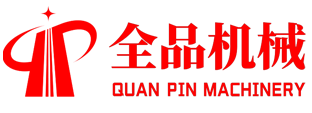
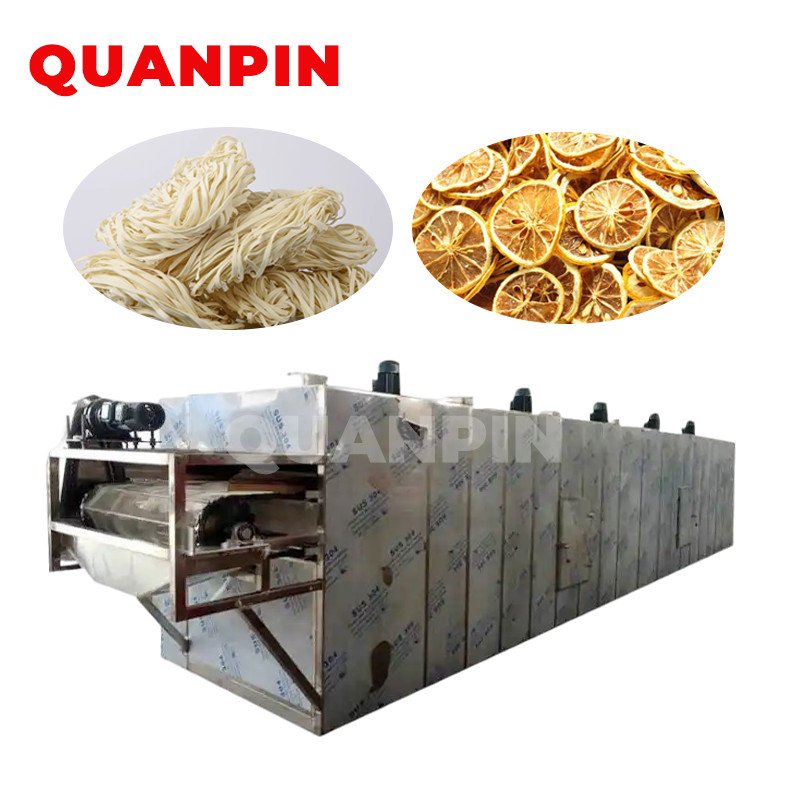
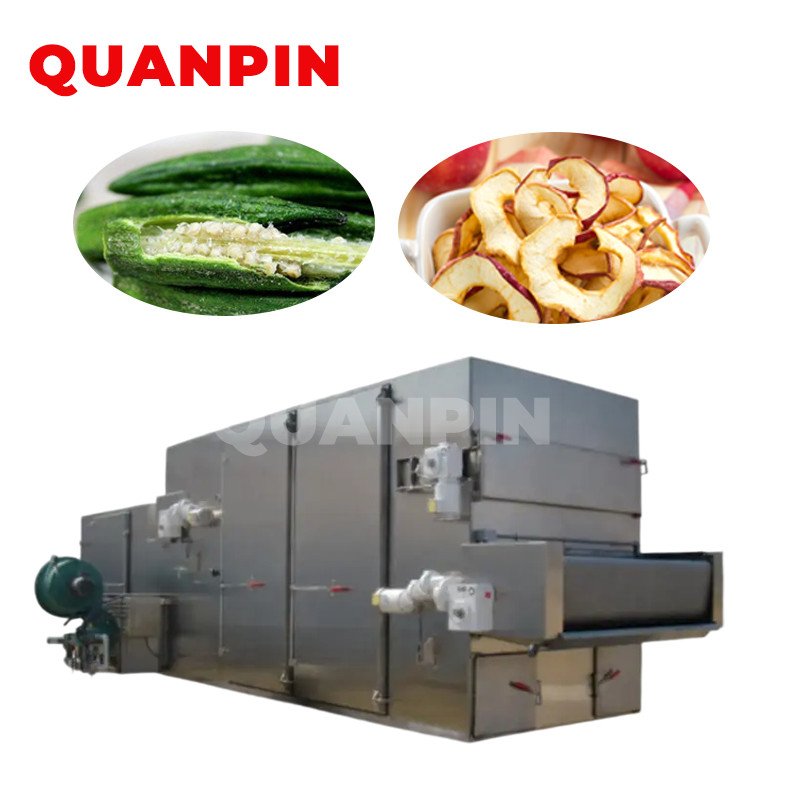
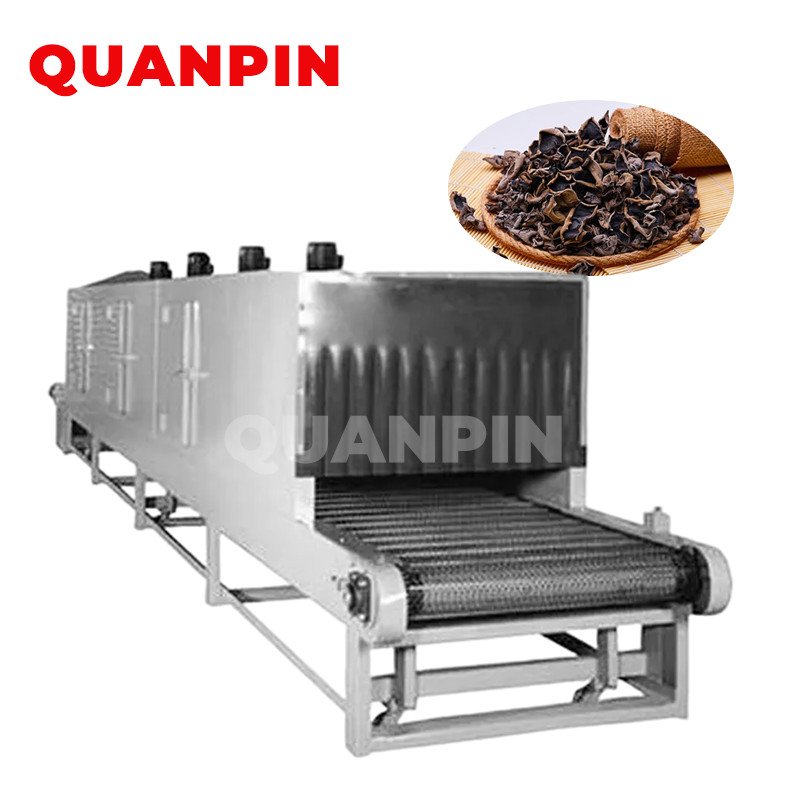
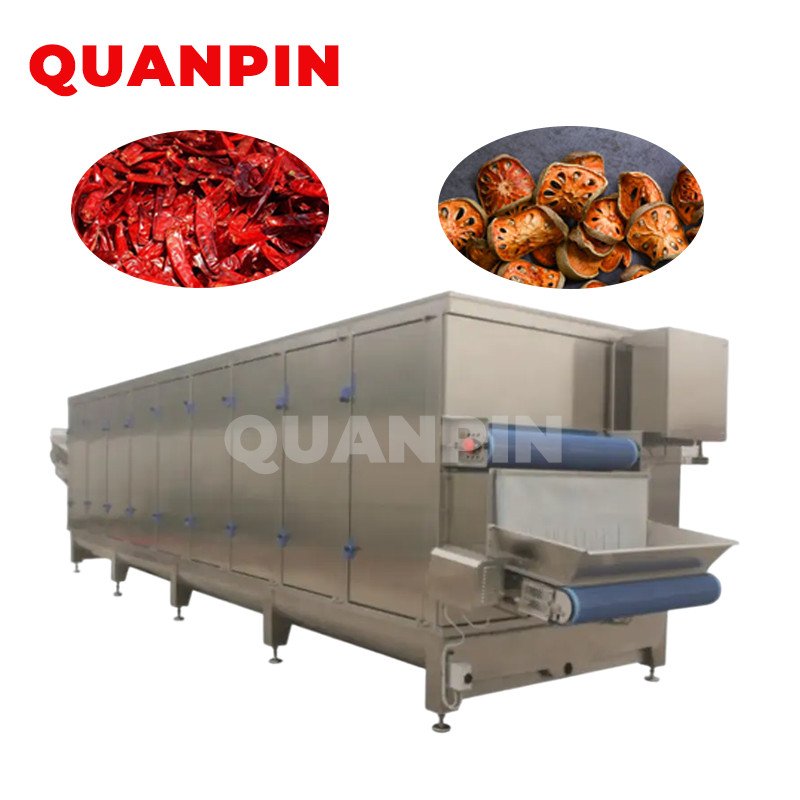
Features of QUANPIN Belt Dryer
The DW mesh-belt dryer continuously conveys material through separately circulated drying sections. It is suitable for permeable strips, slices and particles where controlled hot-air drying is required.
- Independent air circulation in each drying section.
- Adjustable belt speed to match the material and residence time.
- Recirculated hot air to make effective use of supplied heat.
- Forced ventilation through the material layer.
- Stainless steel mesh conveyor for continuous material transport.
- Button control or PLC and touchscreen control on request.
Technical Specifications
| Model | DW Series |
| Belt width | 1.2, 1.6 or 2 m |
| Drying section length | 8 or 10 m |
| Material layer thickness | 10–80 mm |
| Operating temperature | 60–130°C |
| Steam pressure | 0.2–0.8 MPa |
| Belt construction | Stainless steel mesh |
| Control | Button control; PLC and touchscreen on request |
| Adjustable conditions | Belt speed, air conditions and temperature |
| Applications | Suitable vegetables, herbal materials, granules, chemicals and other permeable feeds |
Specifications follow the QUANPIN DW series technical information. Final operating conditions depend on the material and selected configuration.
DW Series Mesh-Belt Dryers
Model selection and application options. Equipment photographs show the DW series; the final configuration is specified in the technical proposal.
DW-1.2-8 Mesh-Belt Dryer
1.2 m belt width and 8 m drying section for continuous drying.
DW-1.2-10 Mesh-Belt Dryer
1.2 m belt width with a 10 m drying section.
DW-1.6-8 Mesh-Belt Dryer
1.6 m belt width and an 8 m drying section.
DW-1.6-10 Mesh-Belt Dryer
1.6 m belt width with a 10 m drying section.
DW-2-8 Mesh-Belt Dryer
2 m belt width and an 8 m drying section.
DW-2-10 Mesh-Belt Dryer
2 m belt width with a 10 m drying section.
Vegetable Drying Application
Discuss feed preparation, bed depth and temperature limits for suitable vegetables.
Herbal Material Drying Application
Assess airflow and residence time for permeable herbal slices or strips.
Granular Material Drying Application
Review particle size, layer permeability and final moisture requirements.
Process Control Options
Discuss button control, PLC, touchscreen and production-line integration.
What Is a Belt Dryer?
A belt dryer transports a prepared layer of material through a heated chamber on a permeable conveyor. Air passes through the belt and product bed to remove moisture while the belt advances continuously. Separately circulated sections allow the drying process to be adjusted along the machine. The appropriate belt width, length and material loading depend on the feed and evaporation duty.
How Does the Belt Dryer Work?
Step 1 — Material Conveying
A feeder distributes material across the mesh belt. An even layer supports consistent airflow and drying. The drive advances the belt at a selected speed, setting the residence time in the drying chamber.
Step 2 — Hot Air Drying
Heated air circulates through the product layer. The DW design uses forced ventilation and air distribution plates to guide the drying air. Airflow arrangement is selected around the material and operating requirements.
Step 3 — Section-by-Section Drying
Each drying section circulates air separately. Temperature and conveying conditions are adjusted to suit moisture removal while respecting the product’s thermal limits.
Step 4 — Moisture Exhaust
An exhaust blower removes a portion of moisture-laden air. Exhaust flow is regulated to balance moisture removal with the reuse of heated air inside the equipment.
Step 5 — Discharge and Heat Use
Most hot air is recirculated within the cabinet. Dried product falls continuously into the collection system at the discharge end. Discuss any downstream cooling, screening or packaging equipment during line design.
Advantages of Belt Dryers
Product Quality
A distributed material layer and controlled airflow help reduce uneven treatment. Select temperature, loading depth and residence time with the material’s final quality requirements in mind.
Continuous Operation
Continuous feed and discharge support integration into a production line. Belt speed can be adjusted to accommodate suitable changes in the feed and drying duty.
Adaptability and Flexibility
Belt dimensions, air conditions and control options can be selected for the process. The feed must remain sufficiently permeable for drying air to pass through it; trials may be needed for sticky or compacting materials.
Effective Use of Heat
Recirculating air reduces the need to heat an entirely fresh air stream on every pass. Actual energy use depends on evaporation load, inlet conditions, exhaust rate and insulation; a fixed percentage saving should not be assumed.
Process Containment
The cabinet encloses the drying area. Dust handling, exhaust treatment and cleaning provisions should be specified for the material. Flammable or solvent-bearing feeds require a separate safety assessment.
Applications of Belt Dryers
Food Industry
Suitable applications include prepared vegetables, coconut materials and other permeable food feeds. Material preparation, cleaning access and product temperature limits should be reviewed before selection.
Chemical Industry
Suitable granular or formed feeds can be treated where airflow through the layer is maintained. Review chemical compatibility, dust characteristics and exhaust requirements for each material.
Wood and Related Materials
Small wood products and suitable biomass feeds may be considered after reviewing size distribution, thermal behaviour and fire risk. Process testing is important where feed conditions vary.
Pellet and Granular Products
A supported conveyor layer can handle suitable granules without the vigorous mixing used in some other drying methods. Check strength, fines generation and permeability when selecting the loading depth.
Frequently Asked Questions
What materials are suitable for a belt dryer?
Permeable slices, strips and granules are typical candidates. Sticky, compacting or paste-like feeds may need preparation before belt drying. Share a sample and process requirements for assessment.
What is the difference between single-belt and multi-belt arrangements?
Different conveyor arrangements change the residence time, product transfers and footprint. Specify the material behaviour and installation space before selecting an arrangement; confirm availability with QUANPIN.
Which heat source should I choose?
Match the heating arrangement to available site utilities, product temperature limits and operating costs. The published DW data includes steam operating conditions; other requirements should be reviewed in the proposal.
Can the dryer connect to other equipment?
Continuous feeding and discharge can be planned with upstream preparation and downstream collection equipment. QUANPIN lists PLC and touchscreen controls as options; communication and monitoring requirements need to be specified.
Send Your Inquiry Now
Start Optimizing Your
Drying Process Today.
Share your material and production requirements with our engineering team.